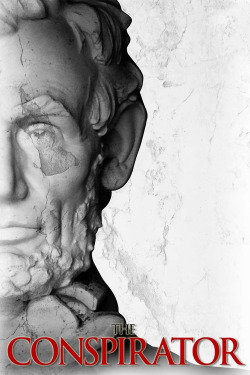
Review of The Conspirator (2011) by Eric R — 30 Jul 2011
Discarding the Constitution When It Becomes Tiresome? Is This 1865 or 2001?
Critics dissociate themselves from both the entertainment industry and each other, so as to appear to have the personal reactionary disposition of one of the everyday folks who want what you and everybody else want from the movies, and then utilizes this partisanship to justify a swing from personal to collective reaction, switching their individual opinions into the engine of public persuasion and the heart of the public field of whatâ(TM)s expected and rejected in moviegoing. When professional opinion-makers criticize a film for asking intellectual interest from its audience, reinforcing the conventional mainstream notion that historical minutiae and civic questions are boring to us or that weâ(TM)re necessarily being lectured rather than entertained, it undercuts the potential a film like The Conspirator has for being engaged by mainstream audiences, which is considerable.
Lincoln is a legendary president, and remains that way in a sense in this film, serving as a catalyst for the legal intrigue and moral and ideological warfare to ensue. In the wake of Boothâ(TM)s gunshot, the lone woman among the band of those charged with conspiracy is boarding house owner Mary Surratt. Her boarding house is where Booth and the gang convened to plan attack. Representing Surratt is the reluctant young lawyer Fred Aiken, whoâ(TM)s gone from defending the Union to defending a woman with utter conviction in the Confederacy. Throughout a patently biased military tribunal, however, Aiken begins to unearth evidence of her innocence. Whether or not his defense will work or the nation will turn against her depends on what kind of justice the nation has in mind. It also depends on whether or not Aiken and Surratt are willing to trust in and work with one another as human beings with a common goal, or defy one another in the name of their beliefs.
Itâ(TM)s not that there are modern political parallels people could see if only theyâ(TM)d wake up, or even that one necessarily must see it as a partisan portrait or essay. Itâ(TM)s that Redford ponders this material in an exceptionally erudite and understanding historical film, running on years of analysis by screenwriter James Solomon. Audiences in the present tense, if they give it a chance, and if marketers trust them, should find it attention-grabbing and relevant. Itâ(TM)s indispensable to reflect that it isnâ(TM)t Surrattâ(TM)s constitutional rights that are being violated, but our own, because the Constitution must be seen to serve unvaryingly for all or it suffers the loss of its power for all. The language and cunning of Lincolnâ(TM)s secretary of war, as played here by Kevin Kline, ricochets with Bush and Cheney in comparable rationalization of the Patriot Act, and Aikenâ(TM)s mentor Senator Reverdy Johnson in Tom Wilkinsonâ(TM)s interpretation here would correspond to President Obama, more a sensitive negotiator than an ideological crusader.
The film relies upon Wrightâ(TM)s rendering of Mary, who has been playing excellent and mostly overlooked roles for years, and McAvoy as Aiken for its human pull. Wright is thoughtfully reserved and muted, carrying a down-to-earth, undemonstrative performance that never cries out for the audienceâ(TM)s pity. Having seemingly decided sheâ(TM)s bound to be found guilty, sheâ(TM)s unwilling to collaborate with her lawyer. In a way, due to his hesitant view of her, heâ(TM)s trying his case against himself. His move to her cause is essentially his reaffirmation to the core constitutional tenets concerned. As he reasons in the military tribunal, for instance, heâ(TM)s arguing about its very occurrence in a case regarding a civilian woman with no function in the military.
Itâ(TM)s important to note that Surratt, both as a person and in terms of her charges, never pleads for our pity. The film does not make her a hot-blooded, valiant martyr. There are no lugubrious stump speeches or built-in opinions. The impact, context and conscience of the story work on their own merits, not via manipulation and foregone conclusion. Redford couldâ(TM)ve switched this material onto auto-pilot at any point to ensure our instant gratification, but he obliges us to reach our own judgment, and that is the importance of The Conspirator. In this handling of an obscure cross-reference of an eminent story, there is an exceptional respect for history and justice rarely found in Hollywood historical dramas, and more precious than ever in an almost entirely commodified time when the mainstream notion of historical context and American diplomacy are predisposed at best.
Redford captures his characters through scenes coiled in fog, soil and cigar smolder, the better to evoke a nation clouded by angst and sorrow. This does not overextend and become expressionism. Indeed, The Conspirator comes unusually close to the urbanity and understatement of a Masterpiece Theater production and creates a visual theme of fluidity.
This review of The Conspirator (2011) was written by Eric R on 30 Jul 2011.
The Conspirator has generally received positive reviews.
Was this review helpful?