Review of The Company of Wolves (1984) by Mattias E — 22 Aug 2009
The 'golden age' of British horror movies was probably the Hammer era, sort of the British equivalent of Corman's pictures except they rose and faded in popularity, rather than remained a cinematic institution. While they initially broke boundaries of sex and violence, by the early '70s, like everything else, they'd lost their shock value, and ever since only once in a generation does a truly brilliant British horror film get made.
Conversely, the early '80s was the golden age of the video nasty, lurid and revolting B-movies made simply as an excuse to show unparalleled levels of gore and depravity. Even some of the era's best horror pics, such as 'Evil Dead' and John Carpenter's remake of 'The Thing' were drenched in gooey viscera. On this side of the pond however, it took an author with a mischeivous sense of subversiveness and a director with a famous compassion for damaged human emotions, to make a horror film was a devastating impact.
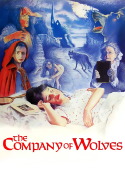
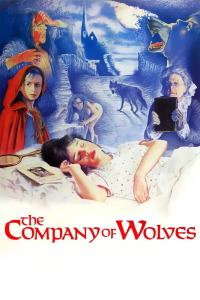
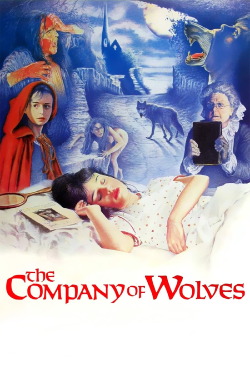
Angela Carter's collection of short stories were wickedly outrageous in their adult re-interpretation of some classic children's stories. In the film, this becomes one of the major themes and one of the primary reasons why it's so terrifying. From the opening dash of a dog through a dreary forest to the closing poem composed in archaic metaphors, everything is constructed with an allusion to the world of folk and fairy tales and how they are ingrained within us forever from being told them at such an early age. But this film is about the much darker, truer nature of these tales, and how their original content was steeped in violence and sexual intrigue. These points are manifest literally in various sequences, most startlingly in the werewolf transformations, but the film's chilling atmosphere comes from the simple nature of childhood. 'Rosaleen's room is filled with dolls and teddies, and her own youthful innocence contrasts with the goriness of the tales; such a creepy sense comes from the fact that everything about childhood, when seen with analytical adult eyes, is deeply disturbing, both in image and in message. Of course to children this unsettling ability is subliminal and hidden, but the fact that it's there only highlights our realisation of the scariness of it all later in life.
In terms of sexual allusiveness, this is easier to find out. All four tales are concerned with the dangerousness of the abuse of sex and how it can result in both physical destruction (the first and third stories) and spiritual destruction (the second and fourth stories). Other visual touches hint at the various stages of Rosaleen's sexual awakening: her red cloak the blood of menstruation, the constant references to hair, her visible attraction to being kissed, her discovery of make up in a bird's nest, all are signs of growing out of childhood. It's somehow less disturbing seeing the 13 year-old Patterson wander through this psychosexual wonderland, chiefly because she isn't exploited, and her own intelligence is evident in her body language and how her curiosity is more in the pursuit of knowledge than of pleasure. She herself is a dangerously tempting object, with her burgeoning curves and astonishingly sensual beauty, but her emotional input and quick-thinking make her far more interesting and memorable than mere eye-candy.
Anton Furst's stunning production design and Bryan Loftus' dreamy cinematography create a visually gorgeous film world, perfectly capturing the film's simmering sexual atmosphere, as well as the coldness and hardness of the nighttime. Small details are dotted throughout that pierce through the fantasy, usually the colour white, such as the rabbit, the rose, Rosaleen's prayer book and the church windows, which ties in with the central matter of whether the whole thing is a dream or not. Debates in movies about the nature of dreams, reality and their existence within one another are notoriously difficult to examine without being blandly pretentious, and while this film unfortunately makes a few of those points, it mostly stays out of this deabte and concentrates on the power of the image; it would rather its own tableaux become the stuff of dreams than make of a sleep-inducing session on them.
But despite all the softness and gentleness, there are truly shocking and terrifying moments. The effects might seem old-fashioned, and even creaky, but its the emotion of the instant that keeps up the excruciating tension. Like all great horror films the messiness of flesh and bone is shown only in brief snippets creating an ambiguous fear over how they'll manifest next time. That said, even some of these sequences have a poignant artistry, particularly in the third act's 'Little Red Riding Hood' story.
What's most surprising, and enjoyable, is the quality of the cast. Usually, horror films are the last place anyone would find anything resembling 'acting', since 90% of horror films are constructed solely for the claret, but 'The Company of Wolves' brilliantly breaks that covention. There's a wealth of iconic British faces here, from David Warner's fatherly vulnerability to Terence Stamp's ghostly cameo. Angela Lansbury plays a role made for her as the waspish grandmother, and while it may seem like typecasting Lansbury actually commands a powerful screen presence with her assuredness and authority. Sarah Patterson is a beautiful revelation, exactly the kind of plucky, independent English rose that proves to be more than capable to handle this bizarre world's obstacles (fulfilling her mother's prophecy that 'If there's a beast in men, it meets its match in women too'.) Stephen Rea turns those creamy Irish features to something horrific, and Micha Bergese, in what sadly seems like his only film role, beguiles and arouses as the feral huntsman. Even Shane Johnstone's big-eared bumpkin provides a lot of the film's wry humour.
Finally, to fit in with the film's mishmash of fairytale eras (everything from the Middle Ages, to the eighteenth century, to even the use of a 1940s-style Rolls Royce) is George Fenton's creepy score. Looping and grating like some kind of age-worn folk song it adds acres to the depth of the film's images, and only tightens the screw even further. For anyone who's ever giggled at the sexual connotations of nursery rhymes, this certainly puts their true meaning into perspective; and where the film really succeeds as a genuinely disturbing horror film is, ironically, because of its own tender heart.
This review of The Company of Wolves (1984) was written by Mattias E on 22 Aug 2009.
The Company of Wolves has generally received positive reviews.
Was this review helpful?