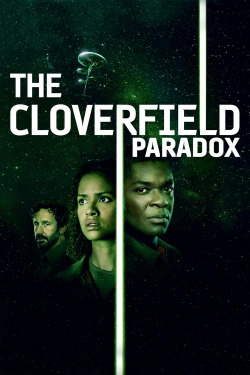
Review of The Cloverfield Paradox (2018) by Walrus B — 10 Mar 2018
I'll try to break this down in a semi-intelligent way because I feel like sci-fi has to constantly be defended and re-defended as a good method of storytelling for people that think it's too "out there" or "just doesn't make sense." It's certainly in part due to movies like this one that this attitude persists. Despite believable sets, props, and acting (somewhat), this movie is unfortunately the kind of science fiction that makes science fiction look really bad.
Gigantic and painful holes line the plot every step of the way. By far the most frustrating is the simple fact that it attempts (very poorly) to incorporate more than a bit of the modern breakthroughs in physics into the story in a way that just doesn't add up. One crew member vaguely mentions a Higgs boson particle and Schmidt says (paraphrasing) "from what we know about quantum entanglement, refiring the Shepherd Accelerator will restore everything to normal." Are you f***ing kidding me? Wow guys; do less research for your movie. All of the scientists also repeatedly refer to the alternate reality to which they have been transported as another dimension, a term that would be highly unlikely for anyone aware of multiverse theory to be using. A small grievance here I know, but still. Putting aside these not even half assedly put together ideas that make the story more than shoddy is the annoying and inexplicable lack of any substantial character development/depth beyond the normally brutal cliché of "I love my family and I just have to get back to them. They're really important to me," expressed repeatedly and unconvincingly (given the circumstances) by the main character. Not to mention that despite the horrific problems that occur with two realities colliding with each other, she (Hamilton) sends the plans for the accelerator to Earth before being transported back to her own reality and fails to mention that the reason that everything went wrong when her team tried to activate it stably was the condensation problem that Tam figured out before she died. "Oh yeah, guess I should've mentioned that little hiccup instead of talking about how family is the only important thing and crying about it. My alternate self probably doesn't know how much I love my family so I better talk about it. It's not like this really complex expensive machine propelled us out of our solar system upside down into another reality. Or that a wall ate a woman and a guy's arm or made another guy have a worm explosion. Well, no big deal, I'm sure they'll figure it out." Yes, I understand she feels regret about the power cell causing the fire back in her reality but can any of us really say that this little speech to her doppelgänger makes any sense provided what is going on?
And why does the only non-Western character have to be a Chinese woman that clearly and irritatingly refuses to speak anything other than Mandarin? She obviously understands other languages (English and presumably German) and the rest of the crew also understands and speaks Mandarin, but the bilingual thing going only one way for her character seems a bit racist and just doesn't make sense. All in all, a sad and stumbling attempt at overemphasizing international corroboration in the movie as well as China's influence on the scientific future of humanity (while simultaneously making her character more estranged and unable to connect with the audience). And of course, the American captain has to sacrifice himself for the good of the team (so unnecessary and over the top), the Brazilian is the Latin American contingent so he has to be the sweet religious one, and obviously the Irish, German, and Russian characters are from the more sordid countries in occidental civilization and all do terrible underhanded things like shoot people and betray their friends because they're violent and conniving. Nothing an American or Brit would ever do, right? Absurd.
Apart from these silly nationality/ethnicity stereotypes that still somehow persist sometimes in movies in 2018, the characters are one-dimensional and there is far too little time spent on character development, the team dynamic, or what specific problems they are attempting to solve as the opening movie montage glosses over their failed first attempts as we see the days count into the 600s. Elements from many other good and bad science fiction movies are noticeable here in a weird mishmash (Alien, Armageddon, Pandorum, Sunshine, Sphere, Life, Gravity, and especially Event Horizon to name a few) to try to cover all bases for any sci-fi viewer without really establishing what objective, if any, this movie really has. This is fitting as the movie is literally about an uncomfortable mishmash between two realities. On top of all this is a murky sense that there is an attempt to be allegorical, but what is the allegory? Beware the dangers of technology? This was overwhelmingly underlined in the first Cloverfield movie. Or is it that the energy crisis won't be solved without other unforeseen problems coming up? Or is it fatalistic (we will destroy ourselves eventually no matter what happens)? If there is an underlying theme or overall message then it's as badly delivered as the rest of the movie; all the way up to the Cthulhuesque monster popping up at the very end. If you value science at all and you value science fiction as a cool and important way to tell stories then please don't see this movie and tell everyone you know not to see it also. The second star is for the film's aesthetics.
This review of The Cloverfield Paradox (2018) was written by Walrus B on 10 Mar 2018.
The Cloverfield Paradox has generally received mixed reviews.
Was this review helpful?