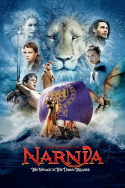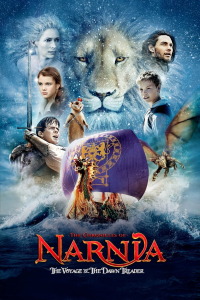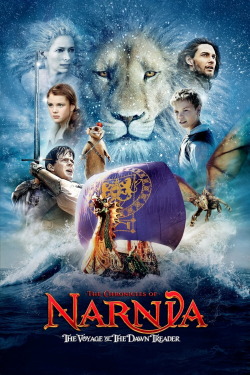
Review of The Chronicles of Narnia: The Voyage of the Dawn Treader (2010) by Shiira — 16 Dec 2010
David Byrne, back in his "More Songs about Buildings and Food" days with the Talking Heads, once remarked that "heaven [was] a place where nothing ever happen[ed]," hardly the sort of place for a swashbuckling rat like Reepicheep(voiced by Eddie Izzard), who seeks action and is absolutely fearless in any given situation.
Assuming that he gets there. Prince Caspian(Ben Barnes) won't go; he politely declines Aslan's invitation to his kingdom, choosing instead to continue his reign over Narnia for the time being, while the wall of tidal water, fluid but frozen in time and space, beckons anybody who wishes to cross over.
The rat, on the other hand, presumed to be much older than his human compatriot in arms, accepts the lion's officer, with the understanding that he just punched himself a one-way ticket. After Reepicheep bids everybody a fond farewell, the loyal Narnian subject lays down his earthly possessions on the sand, and scampers toward the shoreline, where the rat disappears into the blue, similar to the way the sixties activist/writer(played by James Earl Jones) in Phil Alden Robinson's "Field of Dreams" vanishes amid the green Iowa corn, with the difference being that Terrence Mann's trip was a round one.
Prior to the reclusive author's departure, the 1989 film starring Kevin Costner(based on the novel "Shoeless Joe" by W.P. Kinsella) suggests the un-Christian notion of heaven being a place on earth, when the farmer and his father discuss dreams and geography(suggestive of baseball as being a religion to itself), just before they toss around the baseball(practicing their religion), whereas "The Chronicles of Narnia" books by C.
S. Lewis were loaded with Christian teachings that survived the film adaptations, leading the moviegoer to interpret the rat's destination as being heaven, since the mighty lion(voiced by Liam Neeson) is a blatant Christ figure.
Aslan alone can rise up from the dead, the only one who can leave Narnia and return as he pleases, because the lion is all-powerful; he's God, after all, while Caspian can't claim to be nothing more than a mere mortal, but the omnipotent one tempts the prince into willfully abdicating his throne and the remainder of his natural life.
For his own sake, the royal stands his ground, explaining to Aslan that his father would have wanted him to remain among the Narnians, the denizens he was entrusted with by decree to protect. The moviegoer, however, suspects that the prince also wants to live long enough to "catch"(wink wink nudge nudge) the falling star from the "Island of the Star" on their way back home.
Reepicheep, conversely, by his own admission, has seen it all and is all out of fight(and perhaps, all out of love, too, save for one last hug with Lucy), so "dying"(for what else could it be?) becomes easy for the rat, whose derring-do, upon closer examination, was a symptom of his death wish.
As the wind and waves thrashes the Dawn Treader this way and that way during a fierce storm, en route to Dark Island, the rat can be glimpsed flitting around up high on the main yard near the top mast, where one false move could have sent the tiny soldier plummeting to the deck, or worse, the turbulent, churning waters they're navigating.
Even the horseplay, a practice sword fight, that he participates in with his sparring partner Eustace(Will Poulter), after further review, seems less innocent as it first appeared. This boy, Lucy and Edmund Pevensie's cousin, was swinging his blade at the rat pretty hard.
The rat could have easily been the victim of beginner's luck. When Reepicheep jumps into the ocean after the lad, by then, transformed into a dragon, it's with that same dauntless recklessness. Finally, at the beach, the rat reveals his secret desire, as he steps into liquid and, presumably, into the realm of heaven, but doesn't self-murder occasion a trip to the other place? "The Chronicles of Narnia: The Voyage of the Dawn Treader" is more bunk about realms and food for ecclesiastical thought.
The film sorely misses Susan.
This review of The Chronicles of Narnia: The Voyage of the Dawn Treader (2010) was written by Shiira on 16 Dec 2010.
The Chronicles of Narnia: The Voyage of the Dawn Treader has generally received mixed reviews.
Was this review helpful?