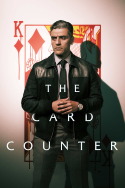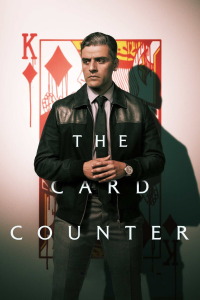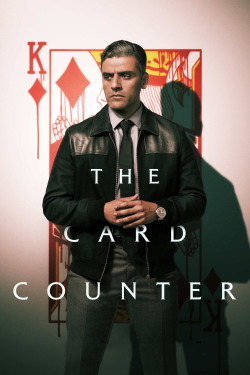
Review of The Card Counter (2021) by Markhreviews — 02 Oct 2021
Writer/Director Paul Schrader was raised by parents who were strict Calvinists (a form of Protestant Christianity that heavily emphasizes the belief that people are predestined to a life of sin because of their universally corrupt natures). His upbringing heavily influenced Schrader’s screenwriting, which gravitates toward themes like sin and salvation. After bursting onto the scene as the screenwriter for Scorsese’s “Taxi Driver” (1976) and following up by writing 1980’s “Raging Bull,” Schrader got behind the camera and began to explore the dark side of human nature in earnest. His previous film “First Reformed” (2017) is the character study of a minister grappling with internal personal despair as well as an existential angst brought on by the climate crisis.
In “The Card Counter,” Schrader again takes a deep dive into the concepts of revenge, redemption and self-loathing. William Tell (based on the fable? a reference to a tic/mannerism that causes a poker player’s undoing?) is a professional gambler tortured by his role as an interrogator at Abu Ghraib. He tries to keep other humans and his own past at arm’s length by traveling to mid-sized cities to participate in lower-level poker tournaments. Playing cards is the mechanism for keeping himself at bay. Keeping his expectations low is his defense mechanism against hope. An award-worthy Oscar Isaac (see what I did there?) is simply spectacular in the role. Along the way, Tell meets La Linda (Tiffany Haddish, playing it straight) who offers him financial backing and, perhaps, more. He befriends Cirt (Tye Sheridan), the bitter son of a fellow interrogator at Abu Ghraib who eventually committed suicide. Tell decides to change his modest career plans to redeem Cirt from his destructive focus on revenge.
Along the way, Schrader uses this story line to speculate about some very big questions: Is interaction with other people truly worthwhile and rewarding? Is the American adventurism of the early 2000s, represented by Abu Ghraib, an indication of a nation rotting from the inside? Is the main constraint on humans the self-limiting choices they make, made worse by their lack of imagination?
Because this is a Schrader film, there are a few predictable elements. As in “Taxi Driver” and “First Reformed,” the protagonist/anti-hero is a diarist, using his writing to describe an internal agony that he cannot vocalize to another human being. This weightiness is offset, occasionally, by some absurdist comic relief. In several scenes, a Ukrainian poker player, decked out in red, white and blue for no apparent reason, is serenaded by loyal fans who chant “U.S.A., U.S.A.” whenever he wins a key hand.
It’s hard to evaluate whether to recommend this film for regular moviegoers. Critics, steeped in the work of Robert Bresson, transcendentalist filmmaking and French New Wave cinema will adore it. For us regular folks, the film’s unflinching examination of its characters, particularly Tell, offer their own rewards. But be forewarned, this film requires moviegoers to fill in some narrative blanks and interpret their own meanings at key points.
This review of The Card Counter (2021) was written by Markhreviews on 02 Oct 2021.
The Card Counter has generally received positive reviews.
Was this review helpful?