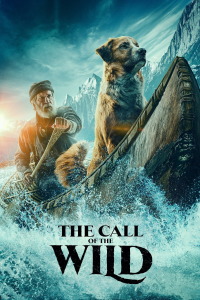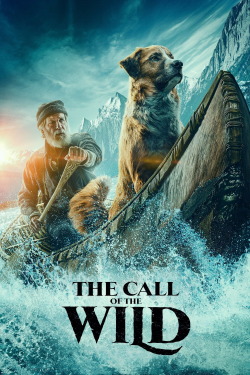
Review of The Call of the Wild (2020) by Chrismizerak — 22 Feb 2020
In order to get into a family adventure film such as “The Call of the Wild”, the first thing you’d need to be able to do is reasonably manage your suspension of disbelief. Because if you are unable to do that, you won’t buy into anything that happens within its story and the experience will be ruined as a result.
And that’s exactly what happened with me when watching “The Call of the Wild”. The story of this film centers on Bud, a dog from the South who gets kidnapped and sent to the Yukon/Northern landscape where he eventually becomes a sled dog, initially against his wishes.
As he finds his ever-changing true calling through navigating the wild landscape, he shares a bond with a kindly old man, played by Harrison Ford, who treats him as an equal. Getting this out of the way bright and early, the biggest problem that sinks this film overall was the decision to have the central protagonist entirely computer-generated from beginning to end.
In all fairness, I understand to a degree why this strategy was taken. To prevent animal cruelty or forcing animals, namely dogs, into training they are clearly not suited for. But if you’re going to take an approach like this to appease your public relations, couldn’t you at least do a better job at convincing us that a dog is really there? Yes, the CGI creation in question is still a dog, but it doesn’t really behave or feel like one.
Now I’m not claiming to be a vet or an expert on animal behavior. Far from it. But even then, I know this much. Animals such as dogs by nature do not have the degree of facial expressions that Bud and a few other wildlife creatures in this film exert.
Furthermore, all animals in the wildlife for better or worse act on their instincts, especially dogs. A fact that is semi-ignored when developing this story. Don’t get me wrong. The random instincts for Bud are there, but they’re all too conveniently placed into the mechanics of the plot.
And if I know something about animals, it’s that this should not be the case. “The Call of the Wild” would have played much better if the animals gave into their instincts much more. To the film’s credit, it establishes a clear connection between Bud and the black wolf he sees occasionally at certain points.
It’s crystal clear that the wolf represents his instincts, and it sets up an interesting concept that this film really should have explored a lot more. Instead, we get in its place an overly obvious, disjointed, and hammy narrative involving a search for gold in the true wilderness with an outright cartoonish antagonist, played by Dan Stevens who painfully overacts his role.
Ford does fine here with a fairly standard character acknowledging the journey Bud has been on. It’s not much to work off of, but he’s reliable with the overall execution. There are a handful of moments that were amusing, mostly related to the messes Bud makes within the first half and not knowing what’s right or wrong.
That is until he miraculously becomes a perfect saint where everything he does is for a reason, part of the aforementioned convenience that makes the developments in the narrative unreliable and unconvincing.
For a film titled “The Call of the Wild”, this film should have ventured much further into the wild than it ends up doing. Instead, it’s just content to go with the painfully obvious, tame, and safe when it comes to its sense of storytelling.
What the story may have in competence, pacing and adhering to tried-and-true formulas, it severely lacks in spontaneity, inspiration and subtlety. “The Call of the Wild” is clearly not the calling to mother nature that we had in mind.
This review of The Call of the Wild (2020) was written by Chrismizerak on 22 Feb 2020.
The Call of the Wild has generally received positive reviews.
Was this review helpful?