Review of The Burnt Orange Heresy (2020) by Hnestlyonthesly — 06 Mar 2020
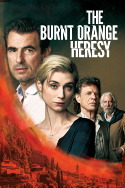
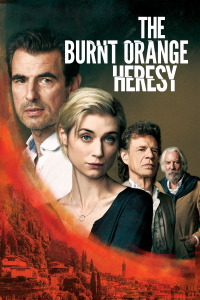
The Burnt Orange Heresy has easily been my favorite film of the Cinequest Film Festival so far. It’s hard to talk about this film without revealing any spoilers, so this might be better for a retrospective after you’ve finished it. Elizabeth Debicki lounges by pools, flirts with men, and plays the “Cool Girl” in the same vein as Amy Dunne in Gillian Flynn’s Gone Girl. Claes Bang plays an imperfect copy of a copy of Pierce Brosnan, slimy, charming enough, constantly impressed by his own cleverness. The two have a coyly fatalistic chemistry.
Early in the movie, the morning after their first night together, Bernice (Debicki) slyly asks, “Do you ever start wondering how something that’s beginning will end?” and the two muse over alternate doomsday scenarios, James (Bang) predicting his jealousy will get the better of him, Bernice foreseeing herself “whored out” at art gala receptions, before James gamely proposes a sort of art gala reception weekend together. Their predictions are both half true, which goes well with so many of the other multivalent moments in this movie: James’s questioning of Bernice’s real name, his suspicion of her accent, the way James tries to hold Bernice accountable for her betrayal in his dream, the provenance of the Debney painting at the end. Neither Bernice or James are anchored firmly in the facts, as displayed by James’s opening monologue, the speech he gives about being an art critic, and by Bernice’s insistence to Debney that she is a rock, not an egg. (“The saddest kind of egg is the one that thinks it’s a rock,” says Debney.).
When the scene cuts to their roadtrip, we hear in the voice over, a message being left on voicemail for Bernice, informing her that her check for a thousand dollars hasn’t cleared. This is our first indication that Bernice may not be all she says she is. What is the overdraft check for? Is it for the abortion we hear about later when she’s removing her “mask” for the elusive Southern painter, Jerome Debney? Even Bernice’s work has created a fiction for her leave of absence: “Officially, I’m on leave to have a cyst removed,” a neat little turn of phrase for a Catholic school teacher’s operation. In which case, Bernice reveals to Debney an incomplete truth. She tells him about the abortion and her sudden impulse to extend her trip through Europe, but not about the way she has dodged paying for her operation. Why does she withhold that information? Is her omission the reason why we get the shot of her footsteps unsettling swarms of flies as they leave the beach, or is that simply foreshadowing her return to the beach later in the film? On that point, who are the flies for? When Debney is questioned about the symbolism of the flies in an artist’s work, he scoffs, suggests the story of the portraits themselves is a myth, which is significant because it mirrors his own story and he’s the first to suggest it as a possibility. Man and his wife I was talking to afterwards said that the movie’s symbols felt crowded and unstable and didn’t really follow through, which makes me think more about the motif of the flies and the way that they interact with James and Bernice.
Bernice and James never quite feel comfortable enough to be honest with the other, in part because Bernice doesn’t want to disrupt the fiction she’s created for herself, but also because James anticipates that his true motives will be anathema to her. Cassidy is in many ways the only person who uses truth, but only when it is to his advantage. He’s asks James if he was “used to validate a fortune” (Girl With a Red Scarf), but he also sells that fake to the TATE. When James asks him at the gallery how Debney dies, he says “heart attack or drowning, they fished him out of the pool and he was quite blue.” The truth for Cassidy is that Debney is dead. It doesn’t matter so much the details of how he is said to have died.
The metatheatricality of James and Bernice’s budding relationship is one of the most delightful parts of this movie for me. The way these two lovers dive into their “first row” by gesturing at the illusion of deeper knowledge of one another is humorous and tense: “Say something bad about my character and make it stick,” he demands. “You treat serious things as if they were trivial and trivial things as if they were serious,” she responds. And before James can yes-and the game with a showy flourish of his savagery, Bernice disarms him with a question which drips with foreshadowing, but at the time feels like an oddly deft yet sweet play on her part.
This review of The Burnt Orange Heresy (2020) was written by Hnestlyonthesly on 06 Mar 2020.
The Burnt Orange Heresy has generally received mixed reviews.
Was this review helpful?