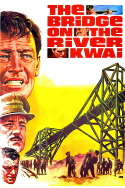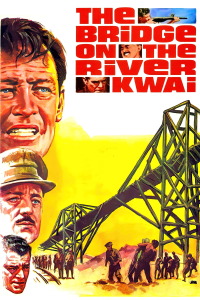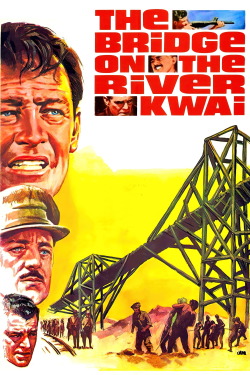
Review of The Bridge on the River Kwai (1957) by Stuart K — 12 Jun 2012
If you're looking for a character drama that gets into the heads of tormented men and explores the actual story, then look elsewhere. If you're looking for a great adventure film that has some great philosophical questions, then you've come to the right place.
It's more like The Great Escape than Apocalypse Now. This film is much like Lawrence of Arabia where every shot looks has brilliant composition. It's another film that would work better on the big screen but is still fantastic on tv.
The Bridge on the River Kwai gives brilliant performances by the entire cast. I was hooked the second that Col. Saito threatens to kill Col. Nicholson and all of his officers for refusing to do manual labor.
Nicholson refuses, stating that it says in the Geneva Convention officers do not perform manual labor. Saito doesn't care about the Geneva Convention. There are no rules, this is war. What's going to happen if he breaks code? Will they come kill him? That's the plan anyway.
But Saito has more to worry about than just what could happen if he breaks the code. He must build a bridge on the river Kwai by May 12th, and if not then he has to kill himself. He doesn't care if what the Geneva Convention says, he has a job that has to get done.
Instead of killing them, Saito puts them in an "oven" and Nicholson in one alone. They become tortured through malnutrition and heat. Hopefully this will change Nicholson's mind. But no.
He won't back down. We think that Nicholson is a strong minded person, but his stubbornness drives him to madness. He takes it upon himself to build a bridge that will last and make his soldiers work hard to get it completed by May 12th, once Saito agrees that the officers won't do manual labor.
During this time we also get the side story of Shears who escaped. He seems to be enjoying himself at a British base with a woman, but they want to take him and put him back in. One thing, he must take a lethal pill before he's caught.
I think what works so well for this film is that we see things from so many different angles. And like Ebert said, the last lines "madness," repeated really ties the film together. It's not like "the horror," but instead we look at each character and what madness means for them.
Nicholson gets to the point that he finds the bridge to be a thing of pride, even though building it is against his own country. He's worried he's getting old and his life has amounted to nothing.
This seems like a strange thing for a guy in the military to believe. He's fighting for his country and everything they believe. I guess when you're captured, though, you start feeling like you failed.
He doesn't even want the bridge to be blown up in the end. It means too much to him. There's even a scene where he takes the sick from the hospital to come and work to get the bridge done on time.
Just let Saito kill himself! But there's the other side. I started to feel for Saito and didn't want him to die. The film presents many conflicting emotions. In the end, we know we should be feeling what the doctor suggests more than what anyone else feels.
I also like the deserted feeling that Shears gets when he finds out the US army knew he changed clothes to impersonate an officer, so they tell the British army they can do whatever they want with him.
So they send him back to the POW camp because he knows the ins and outs. The first half of the film seems more like a game of chicken. Who will give up first? It had to be Saito, because Nicholson was willing to die for what he believed.
This stubbornness plays with the second half. The second half becomes more fun with Shears's adventure. But even through the entertaining adventure there's still many deep character moments that play out that makes us question everything.
Nicholson tells the doctor he doesn't understand the army because he think they shouldn't be working so hard on the bridge. We begin to doubt ourselves as well with his compelling arguments. Another great classic I've gotten to see recently.
This review of The Bridge on the River Kwai (1957) was written by Stuart K on 12 Jun 2012.
The Bridge on the River Kwai has generally received very positive reviews.
Was this review helpful?