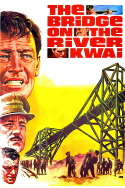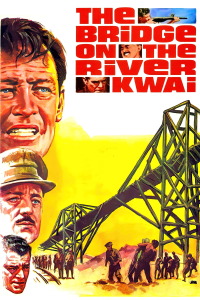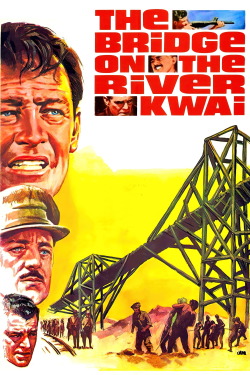
Review of The Bridge on the River Kwai (1957) by Chrismizerak — 09 Mar 2020
There are films based on real people and events that are tailor made for the big screen treatment, in that they lend themselves to an established and formulaic plot Hollywood is used to cranking out. And then there are films such as David Lean’s Oscar-winning war drama “The Bridge on the River Kwai”.
This picture takes a remarkably lesser-known factual WWII story and elevates said story to a state of consistent intrigue and excellence that remains unsurpassed. In what is arguably this actor’s most defining role, Alec Guinness plays Colonel Nicholson, the leader of a battalion of British prisoners of war sent to a Japanese prison camp under the supervision of Colonel Saito, played by Sessue Hayakawa.
Saito assigns the British POW battalion the task of constructing a bridge above the titular river to make a necessary connection that aids the Japanese war efforts. As you would expect, both sides naturally don’t see eye to eye on the management of the bridge construction.
But through a series of brilliantly thought through developments and fascinating reasoning from both the British and Japanese, they follow through on constructing the bridge to the best of their abilities.
Meanwhile, Commander Shears, played by William Holden, an American POW who is able to escape said Japanese camp is being recruited by British Major Warden, played by Jack Hawkins, to join him on a mission to go back and blow the bridge up.
The plot description alone is enough to count me in. But most importantly, the execution of that plot is done complete justice. And the main credit should be given to David Lean’s swift directorial hand and the ingenious script penned by Carl Foreman and Michael Wilson.
To my recollection, I have yet to see another war picture that had similarly challenging moral dilemmas such as the ones faced by the characters of Nicholson or Saito in this one. It is especially impressive to witness Nicholson insist that his battalion carry through with their enemies’ assigned mission for them to set an example for future British soldiers.
Considering the time that this film was made, you normally wouldn’t expect a war drama to be so bold as to venture into such twisted territory or tackle such tricky ideas and themes. And yet not only does “The Bridge on the River Kwai” address such hot button topics head on, but it manages to shape one’s perspective on war that few films in its genre can even hope to recapture.
Many war films show the madness that inevitably results in war, but fewer war films show the psychological manipulation a soldier or a commanding officer experiences by their own doing like this film does.
Nicholson strives to make sense and logic, at least by Britain’s standards, into a situation where sense and logic are seemingly forbidden. Our primary antagonist Saito too is a tortured and conflicted soul himself.
The way the character of Saito is handled, you don’t just see an intimidating officer. You see an officer that is struggling to fulfill his duties due to mismanagement on both sides. His frustration causes him to reluctantly bribe the British officers into fulfilling his orders, even if he already knows the answer he’s going to receive.
There’s a complexity to our antagonist that makes the scenario less black and white. Such little touches like that go a long way. As he would later do with “Lawrence of Arabia”, Lean takes full advantage of the widescreen aspect ratio and gives the overall production a heightened sense of scale.
Top all of this off with the memorable “Colonel Bogey March” along with an outstanding climax and for my money, you’ve got the finest war drama to grace the big screen.
This review of The Bridge on the River Kwai (1957) was written by Chrismizerak on 09 Mar 2020.
The Bridge on the River Kwai has generally received very positive reviews.
Was this review helpful?