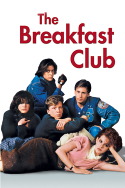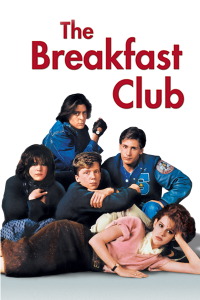
Review of The Breakfast Club (1985) by Kat W — 18 Nov 2014
The brilliance of "The Breakfast Club" is largely lost on those who think of it as a teen movie about high school archetypes. It's not a movie about a rebel, a princess, a jock, a freak, and a nerd; there are no such people.
It is, apologetically, a high-concept play about people trapped in a room until they realize that their similarities are greater than their differences. It rips up Moliere-literally-and adorns itself with the clothes and music and fresh faces of the era's key movie-going demographic, but preserves the close character work, human insight, and polished bon mots of a "serious" work for stuffy theater-goers.
Among the people who didn't notice the script's incredible energy and sophistication were the voters of the Academy of Motion Picture Arts and Sciences, who failed to nominate the script for Best Original Screenplay though it is worthy of favorable comparison with the likes of "12 Angry Men" and Jean-Paul Sartre's "No Exit.
" Similarly, the Academy failed to recognize the accomplishment of Ally Sheedy, who completely transformed herself from the sunny girlfriend of "WarGames" (1983) into the impish, shocking, hilarious Allison of "The Breakfast Club.
" Audiences focused more on Molly Ringwold's girl-next-door appeal, but she is slightly miscast as an alpha female and her screen presence pales next to Sheedy's show-stealing talent. Perhaps most damning of the Academy's ability to recognize quality when it comes in the guise of a popcorn movie is the lack of an acting nomination for Judd Nelson, who shows incredible range and depth as Bender.
Nelson underplays and overplays in exactly the right places as Bender's determination to speak painful truths drives the film and sets off chain reactions within the ensemble. More snubs at Oscar time included the film's tense, cerebral score, and the songs that make up its now-iconic soundtrack of 80s pop picked to play during the beginning, end, and the choreographed montages that break what could be a one-act play into a traditional three-part structure.
Some might criticize the montages for being silly, dated, and disconnected from the plot, and they would be right, but the segments are fun and they let each character reveal his or her nature in a non-verbal context by the particular way that they dance on banisters and slide down hallways.
The only really indefensible missteps in "The Breakfast Club" come near the end, and the timing sours the experience. The makeover scene is hokey and regressive, a too-easy climax that was perhaps meant to suggest the mutability of image and the multiplicity of the individual, but that comes across as a defense of conformity.
A related impulse to pair the characters off is unearned in at least one case and arguably both. The Anthony Michael Hall character's arc is too derivative of Billy Bibbit's in "One Flew Over the Cuckoo's Nest," though the stakes are already high enough without being raised to life and death.
After all, the really interesting question presented by the film is not whether these kids will live, but how they will live. That said, "The Breakfast Club" is not the only work of genius to botch an ending.
Oscar voters, like Assistant Principle Vernon, saw only what they wanted to see and missed the chance to enshrine it in the canon. Popular opinion and critical consensus have been less blind.
This review of The Breakfast Club (1985) was written by Kat W on 18 Nov 2014.
The Breakfast Club has generally received very positive reviews.
Was this review helpful?