Review of The Boys in the Band (1970) by D G — 26 Feb 2011
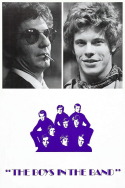
What William Friedkin breaks down in 1970's grimly introspective independent chamber opus is a pre-liberation premise of violence joined with massive gentleness, efficiently encapsulated by ex-alcoholic Roman Catholic homosexual Michael when he offers, "You show me a happy homosexual, and I'll show you a gay corpse." The "boys" are greatly alert to their apprehensions, confronting them whenever they look at their reflections. And it's through reflections that Friedkin finds the sad underbelly of Crowley's script. Since homosexuality and hardcore profanity hadn't been so frankly handled in a mainstream movie yet, Friedkin's approach seems more effective, endeavoring to make his footprint without leaving the gum on the bottom of his shoe. He presents customariness in a cockeyed world where difficulty's inescapable.
During the opening montage, except for Emory's hilarious flamboyance, the boys all appear "normal" enough. Then the wicked lure begins with eye contact. Michael's friend Donald tells him he was brought up to be a failure, so failure's all he feels accustomed to. Donald's oblique eye contact with Michael tells him, and us, that's why they're together. The looks are what tell the truth. Soon, Michael mourns being gay sans asserting it point-blank. He looks at a picture of himself while saying, "Waste, waste, waste." Indeed the dialogue elucidates the character, but by framing Michael within his own portrait, an ageless mirror, an endless remembrance of the past, Friedkin exposes a fading soul. Even former college roommate Alan, who Michael says wouldn't even betray any emotion in a plane crash, suggests compassion, and doubt in Friedkin's visualization. Alan loses control on the phone with Michael, desperate to visit and talk. After Alan hangs up, he grips his hands together, showing his wedding ring. By holding on this image one or two thumps, Friedkin visually places suspicion in our minds about "straight" Alan's intention for visiting his pal.
Plays have no overpowering images. We watch the cast. In films, the camera thoroughly dictates what's seen. When Friedkin animates the camera, involves various angles, the scene feels unspoiled. For instance, near the beginning of the film, Michael, arms heaped with packages, struggles to get inside where the phone's ringing. He can't get the key in, and the ringing becomes a relentless nuisance. Rapid bumpy close-up movements on the keys in his hand, his face and the lock actually develop tension.
When an antagonistic, intoxicated Michael instigates the "truth game," his apartment grows exceedingly oppressive. Everyone's humid, inebriated, clammy. Track lights are turned up, which abruptly give the uneasy feeling of an interrogation. Unlit ceilings, rained-on windows further squeeze the action. There's a great corkscrew energy, the breakthrough of startling insight. And, as time passes, there's a particular tranquility. We're still completely walled off in our own lunacy, but over time, it becomes normal. We're comfortable in the shadows from which Friedkin shoots whilst watching suspicion rise concerning Alan's sexuality, closet doors creaking to and fro, divorced teacher Hank and fashion photographer Larry's clashing on monogamy, and the crevices expanding in Harold and Michael's love-hate rapport.
That Friedkin uses close-ups throughout the game when the guys call the one person they've ever loved intensifies accent on the caller's defenselessness. For instance, when Emory reaches his unrequited love recipient, we suffer his bittersweet elation when he says, "Del, is this really you?" And his sorrow, acknowledging, "You wouldn't remember me. I'm just a friend. A falling-down drunk friend." As Friedkin presses in for a close-up supported by Arthur Ornitz's skillfully murky cinematography, he separates the caller in a congested room, increasing the spectacle of absolute isolation.
It's a parlor murder mystery in a sense. By divulging their deepest skeletons and doubts, the game's like the systematic murder of those who know too much, but in a psychosomatic sense, cruelly exposing their hearts in close-up, revealing a softness within. That Friedkin frames an unforgettable peak moment between Michael and Harold that's both stingingly brutal and honestly tender with Harold first approaching Michael, then isolating the two in frame adds to their unspoken yet implicit closeness.
While the film itself acts as a mirror for exploring oneself, the mirrors in the film perform natural functions. When Michael scuffles for his keys and busts through the door, he sprints past the camera, which pans him inside. He rushes around the corner out of sight to answer the phone, yet we see him reproduced in the living room mirror. We observe it simply owing to his unexpected likeness in it. Friedkin frames the shot with Michael vanishing off one side of the screen and re-emerging in the reflection on the other side, at once opens the film but also foreshadows the cabin fever.
Equally, when Alan calls Michael the second time, it's from a phone booth, the city lights mirrored in the glass surrounding him. But not his reflection. And when he hangs up, we cut outside the booth to incorporate a flashing yield light in the fore. We follow him until he crosses before cars' headlights. When Harold opens Michael's gift, we're in tight on Harold. The hostility between the two temporarily scatters. Friedkin frames them in independent close-ups, divulging their affection, easing the discontent. Temporarily. The friction fosters again. No one knows when it will detonate or who'll be hurt.
The wry humor was hatched from a dejected sense of self, an emotional climate created by what the times told these characters about themselves. Kenneth Nelson, who plays Michael, and Leonard Frey, who plays Harold, characterize this in stark opposition. The cast as a whole matches each other evenly and strongly, yet most memorable, I dare say, Cliff Gorman's Emory. They were told they would keep gay people in a sort of public indigence, in the closet, but all society needed was for it to show them, to familiarize them, and thus integrate them. And it inched the closet door further open for gay characters in media and in all walks of life in our culture.
This review of The Boys in the Band (1970) was written by D G on 26 Feb 2011.
The Boys in the Band has generally received positive reviews.
Was this review helpful?