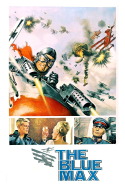
Review of The Blue Max (1966) by Monsieur R — 11 May 2011
George Peppard, now 39 years old, (of Breakfast at Tiffeny's) does a great job as a rookie pilot striving for Germany's coveted Blue Cross, among "other" things. His German superior, Karl Michael Vogler, played Rommel in the great WWII flick "Patton". James Mason plays the German superior to Vogler.
The Blue Max is perhaps an overly long and emotionless, 2 hour plus 1966 American film about an ambitious German fighter pilot on the Western Front during World War I. But its also about a dangerous romance between an airman and a fellow flyer's wife. Ursela Andreus is the playful wife. The action takes place BEFORE the entry of America into the conflict but later involves her entry.
RT writes: "The Blue Max is highly unusual among Hollywood films, not just for being a large-scale drama set during the generally overlooked World War I, but in concentrating on air combat as seen entirely from the German point of view.".
I have to agree. This is a well done WWI flick, not too many of those in great Panavision color. Some of his German co-stars are British speaking, but I guess that doesn't matter too much. After all, Peppard is an American with no attempt at a fake German accent, much to the credit of the movie.
Very well done, acted and photographed, I found this one realistic. A number of combat flying scenes, the pecurliar thing that marks this one is the film as scene entirely from the German perspective. There is a code of honor that is pointed out by Peppard's superior and apparently that is to not kill defenseless men. The code was a relic of chivalry where air combatants appeciated each other, even in combat.
But that relic of war history is dismissed by James Mason as a thing of the past. This is the modern era he proclaims. Well, it was refreshing to see officers willing to stand for more than machine like efficiency. Includes biplanes and tri-planes in vintage condition. The future of the war includes a mono-winged plane as well.
Just a very good, color film about ambition, standards and aerial history. The cinematography and acting by all is really first rate. Whether from the German perspective or otherwise, it really doesn't matter to the quality of this movie.
My only real critcism is the length, 2 and half hours long.
It may be considered "boring" to some. I found it slow, but in the end (and really DO wait for the end), the best WWI film I ever saw made in color. Can be watched more than once too. Still, that passion filled story was a bit absent.
Cast.
George Peppard as Leutnant Bruno Stachel.
James Mason as General Count von Klugermann.
Ursula Andress as Countess Kaeti von Klugermann.
Jeremy Kemp as Leutnant Willi von Klugermann.
Karl Michael Vogler as Hauptmann Otto Heidemann.
Anton Diffring as Holbach.
Harry Towb as Kettering.
Peter Woodthorpe as Rupp.
Derek Newark as Ziegel.
Derren Nesbitt as Fabian.
Loni von Friedl as Elfi Heidemann.
Friedrich von Ledebur as The Field Marshal.
Carl Schell as Von Richthofen aka The Red Baron.
Hugo Schuster as Hans, Elderly Servant.
Alex Scott as The Orator.
Roger Ostime as The Crown Prince.
Directed by John Guillermin.
Produced by Christian Ferry.
Written by Novelist:
Jack D. Hunter.
Music by Jerry Goldsmith.
Cinematography Douglas Slocombe.
Editing by Max Benedict.
Distributed by 20th Century Fox.
Release date(s) 21 June 1966.
Country United States.
Language English.
Budget $6,000,000.
Gross revenue $16,151,612.
NOTES about the film:
1 Peppard wanted to create an "authentic" performance and learned to fly, earned a private pilot's license and did some of his own flying in the film, although stunt pilot Derek Pigott was at the controls for the under-the-bridge scene.
2 The casting of George Peppard in the mainly international ensemble cast was considered a "safe" choice, as he was establishing a reputation for leading roles in action films. Although youthful looking, at 39 years of age, he was much older than the Stachel depicted in the novel.
3 Although the flying scenes were considered the film's redemption, aviation observers cringed at Peppard's wooden, hackneyed characterization of a combat pilot.
4 Music and now famous composer Jerry Goldsmith was introduced to the project with scenes incorporating a "temp track" from Richard Strauss's Also sprach Zarathustra. Goldsmith said of this experience "I admit it worked fairly well but my first reaction was to get up and walk away from the job. Once you've heard music like that with the picture, it makes your own scoring more difficult to arrive at.".
5 The majority of the aircraft used in the film were converted Tiger Moths and Stampe SV.4s. Two Pfalz D.IIIs were produced (by two separate companies) for the film, along with three Fokker D.VIIs and two Fokker Dr.I triplanes. Other German machines were represented by repainted Tiger Moths and Stampes. The British aircraft were similarly mocked-up trainers.
Running time 156 min.
This review of The Blue Max (1966) was written by Monsieur R on 11 May 2011.
The Blue Max has generally received positive reviews.
Was this review helpful?