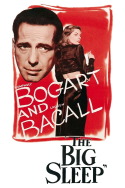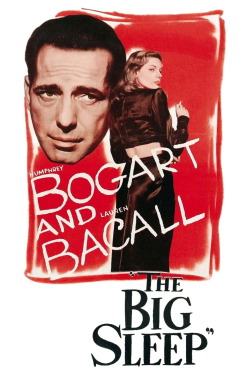
Review of The Big Sleep (1946) by Parker M — 07 Mar 2011
4 Stars out of 4.
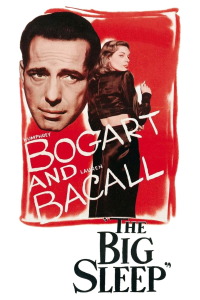
The Big Sleep awoke at a great year for movies (The Best Years of Our Lives, It's A Wonderful Life) - 1946. The war had ended and cinema was no longer associated as war-aspiring propaganda. Howard Hawks's The Big Sleep has no context to the war and is a series of murders and a case of blackmail with very few results. The film is so clever yet there is no payoff needed. It was one of those movies that kept you laughing even when the protagonist, Detective Philip Marlowe (Humphrey Bogart), was staring down a gun barrel.
It was based on a 1939 novel by Raymond Chandler. I've read most of that book. It is a thick read, high on the mood and quick on its toes. When we think of The Big Sleep, people associate it as the film noir where little happens and nothing is resolved. Welcome to the world of Howard Hawks. This director is known for past films like Scarface and he would later direct his glorious swan song Rio Bravo. Known for his hang-around style, The Big Sleep is a murky bit of conversation. Characters trying to take control through their words and Marlowe always coming out on top.
Marlowe is an honest shamus, but that amazes me because he always rants how the pays too low. He is a hero you can rely on. He's confident, agile, smart, and a romantic. His greatest challenge ends up being a greatest romance: Vivian (Lauren Bacall), who is every bit a Philip Marlowe - only a woman. She always means what she says, but doesn't. Her subtext acts like a dangling conversation just waiting to stir argument and further ribbing.
Bogart and Bacall's chemistry is uncanny. You get this feeling like they are not reading each other as characters in the story, but as people in real life. Funny enough, Bacall would marry Bogart when she was 21 and he was 46 - when he died. Their rapport launched an iconic duo that would reoccur in Hawks's To Have And Have Not. This led to a classic line: "You do know how to whistle, don't you?".
There are many more in The Big Sleep. Co-writers William Faulkner, Leigh Brackett, and Jules Furthman take Chandler's snappy writing and turn it into something special. They have this ability to convey one liners that could say more about a character than through a monologue. Carmen, Vivian's troubled sister, says to Marlowe when she first meets him: "You're not very tall, are you?" Marlowe replies with an ironic assurance: "Well, I try to be.".
Carmen is a part of the wealthy Sternwood and Vivian is her more mature sister. Their father, General Sternwood (Charles Waldron) is being blackmailed by a bookshop owner named Geiger. If you've read enough of Chandler, you'd realize all his stories begin with blackmail. The rest of the film is a series of absurd events, that ultimately add up to - well - a sweet romance.
But Hawks is not a traditional romantic. His characters always share this affectionate relationship with each other, even with their enemies. How can we forget the scene with Bacall singing a ditty with a male orchestra, while Bogart watches her admiring her optimism - her beauty and dimension. It's that brief moment in The Big Sleep that all films should have. A break from the action and a peek in on the emotion. All films should have their moments of fragility.
But who can forget the classic contrivance of all cinema's contrivances. Oddly, it does not hurt the film, but rather compliments it. When Hawks and his crew were scrutinizing Chandler's book, they were unsure who killed the chauffeur Owen Taylor. The story notes that Taylor's car was dumped into a river. Was it suicide or death? This was undecided (I would assume it was murder because that was Chandler for you and it was called 'the big sleep' is a euphemism for an ugly death). So Hawks called up Chandler and inquired. Chandler scanned over his material and confessed he had no idea. But it works because Chandler, and then Hawks, had crafted too well of a story.
In a whodunit like The Big Sleep we expect a big twist - a shocking realization. But the film has so much fun solving a case that keeps deflecting into aimless directions. Bogart embodies Marlowe so that he does not need a gun to intimidate, just his words. He can take control of a situation without a pounding fist and he loves to collect guns. This Marlowe is very self-aware of himself and the women find him "cute" - where Bogart was usually considered an unattractive actor made homely based on his charisma. In 1978, The Big Sleep would spawn a remake with Robert Mitchum - a more passive, restrained dick.
But The Big Sleep is one of those films not engaging through its plot or direction. In fact Hawks has the curtesy to let his actors act and his story to tell. Chandler had already provided. The Big Sleep, a landmark in film noir, is a convoluted story made lucid by a great director, who proves (like Marlowe) there is nothing he can't fix.
This review of The Big Sleep (1946) was written by Parker M on 07 Mar 2011.
The Big Sleep has generally received very positive reviews.
Was this review helpful?