Review of The Big Sleep (1946) by Rick T — 12 Apr 2015
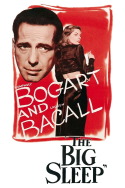
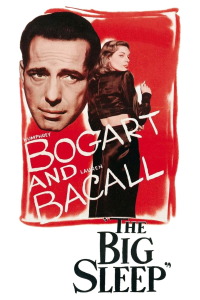
Only a tick after the Warner Brothers logo and theme song fill the room do the silhouettes of Humphrey Bogart and Lauren Bacall appear, trading cigarettes, exuding the allure only found behind the angular sunglasses of a dragon lady or a glamorized goon. Their names then appear with the rush of a bold statement; in 1946, they were the titles of stars, of top-drawer actors. In 2015, they're godly, legendary, untouchable. As the shadowed bodies, the gigantic names, and the dangling cigarettes of the leads appear before the title of the movie itself, a tone is already established. "The Big Sleep" will be a film in which Bogie and Bacall prefer slippery chats over liquor and smoke to breathy romance; it will be a film in which style, wit, and danger come first and intelligibility follows second.
"The Big Sleep" is perhaps the film noir, the quintessential Bogart and Bacall pairing, the movie that sidestepped the sunniness of all those Technicolor, 1940s morale boosters in trade of something almost unhinged in its cool. It was the film that initially showed me just how beguiling actors could be, how captivating pure cinema could be, how bewitching dialogue could be. I've seen "The Big Sleep" twenty times or so (who's counting?), but each viewing brings some new discovery unnoticed by the previous undertaking. My last was an attempt to introduce my sister to its enticing world. This time around, some months later, I find myself reenchated by the chemistry between Bogart and Bacall, more appreciative of the silky screenplay. Each viewing changes - some are out of a nostalgic need, some are out of a desire to consume flawless filmmaking - but one thing always remains the same: no film has ever matched "The Big Sleep"'s unflagging ability to excite.
This is an amazing accomplishment for a film that doesn't make any sense - famously, the author of the novel, the incomparable Raymond Chandler, had a hard time deciding if a major character had been killed or had committed suicide - but one doesn't worry about plot twists or big payoffs here. We become so wrapped up in the stunning rapport between the leads (to be married after completion) and the quick (but razor sharp) dialogue that it's easy to forget that films normally, you know, make sense. It's not a case of style over substance but rather style with substance that gives us many memorable moments that just so happen to lead to nowhere. But those moments.
It's the story of a private detective, Phillip Marlowe (Bogart), and a case given to him by the poisonously wealthy General Sternwood (Charles Waldron). It seems that one of Sternwood's wild daughters, Carmen (Martha Vickers), has put herself in the middle of a blackmailing scheme, and the girl, thumb-sucking and Lolita-esque, is too naïve to get herself out of the racket. Marlowe, sardonic and clever, is the perfect man for the job - but the case, as it turns out, is much more complicated than it appears to be. It also, unfortunately, involves a murdered pornographer (Theodore von Eltz), a secretive gambling-house proprietor (John Ridgely), Sternwood's other daughter, Vivian (Bacall), who Marlowe is attracted to, and more shady figures.
As Marlowe wanders around in this muddled labyrinth of captivation, it's difficult to keep up with his thoughtful antics; but it isn't hard to find ourselves smitten with the hard-boiled world Howard Hawks and his congregation of screenwriters (including William Faulkner, Leigh Brackett, and Jules Furthman) concoct for us. Enhanced by Max Steiner's fierce score, interludes don't slow things down but rather keep the swiftness of everything intact; scenes, in the meantime, are brimming with such fantastic exchanges that it's difficult not to laugh along with the virtuosic lines the actors challenge each other with.
And if the actors aren't part of the atmosphere, then they're sticking out of it, making it. Whereas Bacall stole scenes from Bogart in 1944's "To Have and Have Not", her career defining debut, in "The Big Sleep" they are equal, equally sensational. Bogart played several interesting men in his long career, but Phillip Marlowe is one of his most intriguing parts, surely among his finest performances. He can spit out lines at a machine gun pace, all the while cherishing Marlowe's dexterity, having fun with it. And though only Bacall's second movie (filmed before 1945's "Confidential Agent", which nearly destroyed her blossoming career), she is a presence in the same way Dietrich or Garbo were in their early days: positively magnetic and unlike anything else found on theater screens of the time. Together, Bogart and Bacall almost set the camera on fire, and not just during love scenes; their real-life romance makes every scene throb with intrigue, and it still shows today. Supporting performances, particularly from the underrated Martha Vickers and Sonia Darrin, make huge statements, no matter how small the part.
Almost 70 years later, "The Big Sleep" remains vital. It's a landmark in the personal lives of its stars, a landmark in cinema, and a landmark work for a director so versatile that "Gentlemen Prefer Blondes" and "Red River" are completely separate yet somehow fronted by the same man. I'll probably watch it twenty more times, but until then, "The Big Sleep" is one of the best films ever made.
This review of The Big Sleep (1946) was written by Rick T on 12 Apr 2015.
The Big Sleep has generally received very positive reviews.
Was this review helpful?