Review of The Big Lebowski (1998) by Blake P — 02 Dec 2015
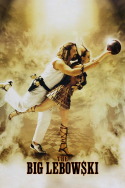
So many comedies are forever doomed to rely on the laughs that follow a frenzied misunderstanding or a particularly well-placed one-liner, often so forced in their efforts to provide us with a knee-slapper that sitting back in horror is sometimes more natural of a response than a chuckle. But "The Big Lebowski," the ultimate cult film unless you count the horrors Rocky provided in 1975, is a comedy that feels alive, despite its leading character's tendency to drift off ignorantly into his own little world of White Russians, joints, and Captain Beefheart.
Like "The Big Sleep," to which it is often broadly compared, its mood is more quintessential than razor sharp, knowing intelligence - and where "The Big Sleep" seamlessly concocted noir flavors and mouthwatering cool, "The Big Lebowski" is a hazy maze of comic buffoonery, labyrinthine but hypnotic. You don't want to pull away from its Woodstock attitudes and eccentric characters, which is most likely why it has proved to be popular enough to inspire Lebowski centered film fests and even, oddly enough, religions based on the positions of its titular dude.
Could "The Big Lebowski" be made by anyone other than the Coen Brothers? Maybe a less violence oriented Tarantino, but I'm not taking chances. It is a culmination of what they do best - drawing thickly felt characters while marinating them in believably quirky, and believably deadpan, situations that take themselves seriously as we sit back and guffaw with a passion. This is one of their best films - lovable, in control, and droll.
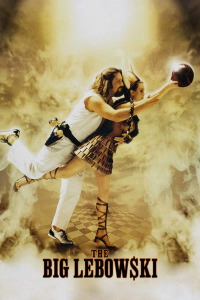
By now, film nerds are familiar with Jeff Bridges's portrayal of the titular Jeff "The Dude" Lebowski, who has become embedded in popular culture as the archetypical slacker. Unemployed, pot-smoking, and just as fond of the phrase "chill, man" as he is ready to spout out profanities like a bothered hippie, he spends his days bowling with his buddies, fire-tempered Vietnam vet Walter (John Goodman) and the passive and dim-witted Donny (Steve Buscemi). His bathrobe, dirty T-shirt, loose shorts, and plastic sandals may as well be a uniform.
One could say that his lifestyle is pretty lax, and that his worries are next to none. So when he is mistaken for millionaire Jeffrey Lebowski (David Huddleston) by a gaggle of foolhardy thugs, who break into his home, give him a facial cleansing of toilet water, and pee on his favorite living room rug, the sudden attention makes him an important person of sorts. Pissed at the vandalization and the injuries, he confronts the other Lebowski at his vast California mansion, hoping to get a decorative refund thanks to that bad bout of mistaken identity.
But the rich Lebowski, loud and impatient, doesn't much want to give The Dude a refund. So he throws him out of his home. Days later, though, Lebowski calls upon the stoner out of nowhere to make him a proposition: for a sizable sum of money, he wants The Dude to deliver ransom money to his wife's (Tara Reid) kidnappers, who just recently abducted the woman and are threatening a violent death. No problem, he says. But Walter interferes, the plot goes hopelessly wrong, and things get interesting, with The Dude meeting all sorts of idiosyncratic characters, like Lebowski's artist daughter Maude (Julianne Moore), and a group of German nihilists more violent than their stupid manner might suggest.
Despite the fact that I've spent the last three paragraphs going through the motions of the storyline, "The Big Lebowski" isn't so much about its plot as it is its quirkily humorous tone, and the Coens' boundless drive to do anything for a laugh. Not in the Mel Brooks sort of way, offensive and slight - they, like Altman or Paul Thomas Anderson, realize the many possibilities of comic delirium that come along with introducing a hell of a lot of characters. The Dude is a hero for the ages, a couch potato lazier that Jabba the Hut (he's lardy but heads a criminal conglomerate, which counts for something) and more equipped with personality than most protagonists in the movies.
Bridges is supported by a first-rate cast, who speak and live the Coens' words with a great deal of tenacity. Goodman takes aggression and makes it hilarious rather than off-putting, Buscemi is dull but sweetly unassuming, and Huddleston is appropriately Eugene Palette in his mannerisms. But I especially am in wonder of Philip Seymour Hoffman and Moore, who are able to play absolutely ridiculous characters (the former a devoted servant with tremendous patience, the latter an erotic painter who completes her works in a saddle swing, naked) with a straight face - they provide the film with some of its most sizable laughs. No one, however, compares to The Dude - is there anyone like him?
"The Big Lebowski" gets better with age, its offbeat humor sweetening as time passes and the "Scott Pilgrims" and "Inherent Vices" gain prevalence in the cinematic world. I saw it for the first time three or four years ago, and it was as shining then. Yet its eccentricities tighten with familiarity, and I won't be much surprised if I see it again sometime soon. It's too itself to want to forget; it's one of the best comedies ever made.
This review of The Big Lebowski (1998) was written by Blake P on 02 Dec 2015.
The Big Lebowski has generally received very positive reviews.
Was this review helpful?