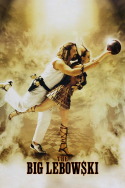
Review of The Big Lebowski (1998) by Thegodfatherson — 12 May 2013
The Big Lebowski" is about an attitude, not a story. It's easy to miss that, because the story is so urgently pursued. It involves kidnapping, ransom money, a porno king, a reclusive millionaire, a runaway girl, the Malibu police, a woman who paints while nude and strapped to an overhead harness, and the last act of the disagreement between Vietnam veterans and Flower Power. It has more scenes about bowling than anything else.
This is a plot and dialogue that perhaps only the Coen Brothers could have devised. I'm thinking less of their clarity in "Fargo" and "No Country for Old Men" than of the almost hallucinatory logic of "Raising Arizona" and "The Hudsucker Proxy." Only a steady hand in the midst of madness allows them to hold it all together--that, and the delirious richness of their visual approach.
Anyone who cares about movies must surely have heard something about the plot. This is a movie that has inspired an annual convention and the Church of the Latter-Day Dude. Its star, Jeff Bridges, has become so identified with the starring role that when he won the 2010 Oscar for Best Actor, Twitterland mourned that his acceptance speech didn't begin with, "The Dude Abides." These words are so emblematic that they inspired a book title, The Dude Abides: The Gospel According to the Coen Brothers, by Cathleen Falsani. This is a serious book, though far from a dreary theological work.
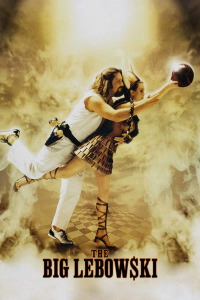
The Dude is Jeff Lebowski, an unemployed layabout whose days are spent sipping White Russians and nights are spent at the bowling alley. There is always a little pot available. He has a leonine mane of chestnut hair, a shaggy goatee, and a wardrobe of Bermuda shorts, rummage sale shirts, bathrobes and flip-flops,. He went to Woodstock and never left. He lives in what may be the last crummy run-down low-rent structure in Malibu. Trust the Dude to find it.
It is widely known that the Dude was inspired by a real man named Jeff Dowd, a freelance publicist who was instrumental in launching "Blood Simple" (1984), the first film in the Coen canon. I have long known Jeff Dowd. I can easily see how he might have inspired the Dude. He is as tall, as shaggy and sometimes as mood-altered as Jeff Lebowski, although much more motivated. He remembers names better than a politician, is crafty in his strategies, and burns with a fiery zeal on behalf of those films he consents to represent.
In the film, Jeff Lebowski tells the millionaire's daughter (Julianne Moore) that in his youth he helped draft the Port Huron Statement that founded Students for a Democratic Society, and was a member of the Seattle Seven. In real life Jeff Dowd was indeed one of the Seattle Seven, and remains so militant that at Sundance 2009 he took a punch the jaw for insisting too fervently that a critic see "Dirt," an ecological documentary Dowd believed was essential to the survival of the planet. True to his credo of nonviolence, the Dude did not punch back.
In "The Big Lebowski," our hero has left politics far behind, and exists primarily to keep a buzz on, and bowl. He is never actually drunk in the movie, and always far from sober. His bowling partners are Walter Sobchak (John Goodman) and Donny Kerabatsos (Steve Buscemi). Walter, even taller than the Dude, is a proud Vietnam veteran and the strategist of the three. He and the Dude never mention politics. Donny is their meek sidekick, always a step behind the big guys. He says perhaps three complete sentences in the film, all brief, and is often interrupted by Walter telling him to shut the f--- up. He is happy to exist on the fringes of their glory.
Details of the plot need not concern us. It involves a mean-tempered millionaire in a wheelchair who is the Big Lebowski (the Dude becomes, by logic, the Little Lebowski). He broods before the fire in a vast paneled library, reminding me of no one so much as Major Amberson in "The Magnificent Ambersons." His trophy wife Bunny (Tara Reid) appears to have been kidnapped. This leads indirectly to the Dude being savagely beaten by hit men who mistake him for the Big Lebowski. Well, how many Jeff Lebowskis can there be in Malibu? One of them urinates on The Dude's rug, which he valued highly ("it pulled the room together"), and the whole movie can be loosely described as being about the Dude's attempts to get payback for his rug.
The inspiration for the supporting characters can perhaps be found in the novels of Raymond Chandler. The Southern California setting, the millionaire, the kidnapped wife, the bohemian daughter, the enforcers, the cops who know the hero by name, can all be found in Chandler. The Dude is in a sense Philip Marlowe not in his energy or focus, but in the code he lives by. Down these mean streets walks a man who won't allow his rug to be pissed on. "That will not stand," he says, perhaps unconsciously quoting George H.W. Bush about Saddam's invasion of Kuwait. The Dude does not lie, steal or cheat. He does swear.
This review of The Big Lebowski (1998) was written by Thegodfatherson on 12 May 2013.
The Big Lebowski has generally received very positive reviews.
Was this review helpful?