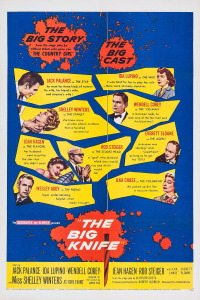
Review of The Big Knife (1955) by Alex F — 23 May 2008
Procrastination turns out to be rather germane; in The Big Knife, movie star Charlie Castle (Jack Palance, of whom I grow fonder with each film of his I see) puts off signing his new contract with the studio, afraid of and disgusted by what his career has turned him into, and hoping, by refusing to sign, to win back his wife, son, and sanity. For all the putting off, though, there is something supremely satisfying about doing the deed at last (for Castle, that deed is the ultimate refusal to sign, quickly followed by a wet and bloody suicide with a knife in the running shower). After all, we have watched his agent, his trainer, his producer, his producer's assistant, his estranged wife, his friend (who is also openly his wife's lover), his PR manager, and a hapless starlet swirl around him, drinking and shouting and threatening and accusing and hitting and making up, in the very compressed space of his Hollywood home's open entertaining area: the front door, (entrance, stage left) and its catwalk into a living room with wet bar, sliding glass doors out to the patio (exit, stage right) and a spiral staircase (upstage), leading to the private space upstairs, intimating the diegetic sex and suicide, but protecting us from it.
We find ourselves, then, in the pressure-cooker of a stage play, a domestic melodrama of the glitterati, where a dark secret (a year prior, Castle was the driver in a hit-and-run accident that caused the death of a child; that aforementioned hapless starlet, with whom he had been having a negligible affair, was his passenger) and its cover-up (someone else from the studio, more expendable, took the blame and went to prison, and the starlet was given a few walk-on roles to keep her quiet) is the rock, and the threat of divorce is the hard place; not signing means the studio publicizes the whole ugly truth, and Castle gets sent to jail, while signing means that Castle loses his wife and son. And everybody, Castle included, is just plain mean and ugly (with the exception of Castle's trainer, who, untroubled, acts more like a faithful dog than a man). And so the deed, however painful, is a relief, for Castle, for his compatriots, and for the audience.
This review of The Big Knife (1955) was written by Alex F on 23 May 2008.
The Big Knife has generally received positive reviews.
Was this review helpful?