Review of The Big Easy (1986) by La L — 22 Jun 2011
Featuring a Random Assemblage of Accents.
I do not know why Jim Garrison is in this movie. This isn't even just that there's a certain irony to having Jim Garrison preside over a trial in a movie wherein the mob and police corruption play important roles. Though there is something to be said for that. It's that Jim Garrison was only famous in certain specific circles at the time. The stir he'd caused over Kennedy had long faded outside conspiracy circles by then, and Oliver Stone hadn't yet stirred it back up. It's a very minor role, one where he gets few lines and little screen time, though I suppose any was enough to Garrison, who never met a camera he didn't like. It might be intended to add local colour, but I don't think it really does. He isn't in the movie long enough to have a personality, and unless you know who Jim Garrison is, and I'd posit that very few people did then and do now, he's just some funny-looking guy who plays a judge, and Hollywood is full of actors who can do that. Probably New Orleans is, too.
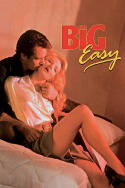
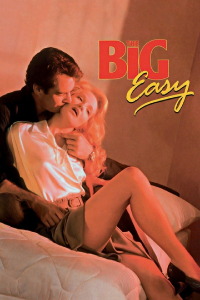
We also have Dennis Quaid, the better-looking Quaid, as Detective Remy McSwain. Remy is a cop from one of those huge families of cops--he does have a cousin who's a fireman, though. He meets the new DA in town, Anne Osborne (Ellen Barkin), and woos her. She falls for him, and that might be good, except he gets busted in a bribery sting. Which is not so good. It turns out that he's one of those cops who looks at interminable petty corruption as "the way things are," not as something to be fixed. And as the film progresses, we find out that the petty corruption which is just part of life as a New Orleans cop does tend to lend itself to sliding into more major corruption. Taking a bribe from, say, a strip club owner can lead to taking a bribe from, say, a major mob figure. Remy knows that being bribed by wiseguys is wrong. Anne knows that being bribed is wrong, full stop. And it turns out that there are murders which just might be committed by cops.
Don't let anyone fool you. This is not neo-noir. We start with the fact that there is no femme fatale. Barkin plays a Crusading Attorney, a whole different category, and the only other female characters are Lisa Jane Persky as Token Female Cop and the wonderful Grace Zabriskie as the Stern and Protective Matriarch. There are none of the visual cues; just having scenes happen at night does not noir make, and the weather is pretty clear through most of the movie. It's true that not everyone is who they seem, but that's pretty par for the course in any movie about corruption. Logically, it would have to be. There are differences between authentic '40s and '50s noir (and those movies which might be proto-noir from the '30s) and neo-noir, but not all that many. Mostly to do with the fact that pretty much everyone uses colour film these days, really. There are even ways to twist the genre. They are not being used here.
Honestly, I find the whole thing pretty pedestrian. We know that Remy will end up with Anne, even though they seem pretty mismatched going in. And at the end, come to that. We know that Remy will root out the really corrupt people, because he isn't [i]really[/i] corrupt. He is even able to stand up and distance himself some from "the way things have always been." Dennis Quaid is, Gods know, better looking than Randy, but neither is any great prize. Ellen Barkin is not unattractive, but she's not someone you'd turn your head to watch walk down the street. They're both decent actors, but not great. John Goodman and Ned Beatty as other cops in the department do some fine work, too, but none of these people are doing anything all that complicated. There's nothing really notable about this movie so far as I am concerned. It's just yet another movie where a basically good guy manages to distance himself from friends who are leading him astray and do what's right. This, we've seen before.
In theory, I suppose New Orleans is playing itself, but it's playing itself in the same way that a lot of figures known for being larger than life do. New Orleans is mostly being played for two things, which are zaniness and corruption. Every once in a while, I encounter a movie set during Carnival in Rio which has locals annoyed because it enforces the impression that there's nothing else to Rio. I mean, at least this movie doesn't actually take place during Mardi Gras--though it's mentioned once, and a warehouse with bits of floats is shown at one point. However, this may in part be because the original screenplay was set in Chicago, another great city in the history of corrupt American police forces. But the range of accents in this movie is impressive, if not convincing, and it's made quite clear that you can't throw a rock without hitting a club or family gathering which involves live music in some way. Other than that, the city is pretty generic. Even with Jim Garrison.
This review of The Big Easy (1986) was written by La L on 22 Jun 2011.
The Big Easy has generally received positive reviews.
Was this review helpful?