Review of The Big Chill (1983) by Brett C — 18 May 2014
Review In A Nutshell:
Before when I used to hear the name Lawrence Kasdan, my mind seems to automatically draw up Star Wars or Raiders of the Lost Ark. Now when I think of Lawrence Kasdan, I see The Big Chill.
The Big Chill's plot is quite simple. It's about a couple of college friends reunited unfortunately due to a recent loss of a member within the group. This is a kind of film that doesn't seem give the audience a resolution they would be expecting, and this is maybe due to the story lacking in any newly elevated complications. Instead, the issues are things that have already happened, and the characters are just trying to simply reflect on that; while still retaining some sort of connection to the death of their close friend. I personally didn't mind that the film's plot progressed this way as this prevented me from guessing how things would eventually resolve.
If The Breakfast Club was about the audience getting in touch and reflecting on a generation of young adults in the era of the 80s, The Big Chill would be a reflection on the people who have reached and transitioned to this decade as an adult. It explores ideas of lost opportunities, hope, expectations, and aspirations. Each character in this film seem to be miserable or at least disappointed in some sort of way, as when they were much younger, they expected life to be different and be as fulfilling they thought it would be. Though I think stories like these are quite interesting and somewhat feel more genuine than most films out there, I can't feel a strong connection with the issues and the way of thinking that the characters have; and I think it has something to do with me not reaching that stage in my life quite yet. I attached heavily on the lead characters of The Breakfast Club because it captured the fragility and irremediable fractures of youth, while The Big Chill seems to explore ideas that are also authentic but they still feel somewhat foreign to me, that is not to say I cannot empathise as their issues on the surface still feels heartbreaking to watch but emotionally, I just can't get beyond that barrier.
The film's cinematography was satisfying for a film of this nature. Mainly composed of shots that emphasises the beauty of the actor's performance. Since the film primarily takes place indoors, it would have been nice if the film felt less cinematic, as at times the photography tried a little too hard to suck me in to the story of the characters. Connection with the film's character and story should come naturally. The film also contained a couple of beautiful wide shots, particularly, the scene in the graveyard. The film's musical element is completely composed of tracks from pre-1970s, though I may be wrong as some tracks that I am not too familiar with may actually be from the 70s. I adored the film's soundtrack as a lot of it are songs that I am already a fan of, but what really made it work for me is the way songs connected with the film's story so perfectly, that I may have a new perspective of what that song really means. Kasdan has a wonderful ear and doesn't require an original score in order for the film to hit it's marks.
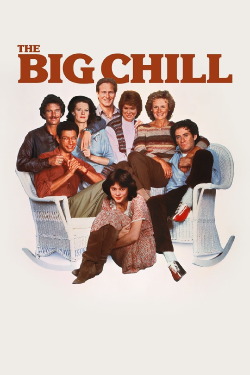
The film has a wonderful cast that features Glenn Close, Tom Berenger, William Hurt, Kevin Kline, Meg Tilly, Jeff Goldblum, Mary Kay Place, and JoBeth Williams; most of them still have yet to catch their big break in the business when this film was released. Even though the cast in this film is considered now to be spectacular, there was only really one actor, or should I say actress, that showcased their top performance in this film, and that acclaim would go to Glenn Close. This film proved to me why she is such a great actress; then again I only have this film to base the praise on as I have yet to see her other notable films like Dangerous Liaisons and Fatal Attraction. The other actors in this film were good but didn't make as much an impression on me as Close did. I also want to point out that this film also contained Kevin Costner who was also in the beginning of his career, but was sadly cut out of the film; he played the friend that the characters mourned for.
The Big Chill is a film that contains a lot of good traits, but because of it's subject matter, I wasn't able to be fully attached with the film's themes and ideas. I think this would be a film that I would adore as I get grow physically, emotionally and spiritually.
This review of The Big Chill (1983) was written by Brett C on 18 May 2014.
The Big Chill has generally received positive reviews.
Was this review helpful?