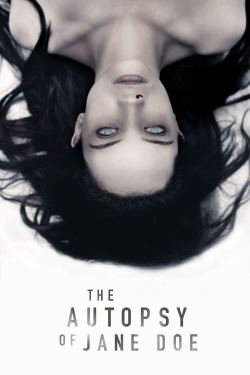
Review of The Autopsy of Jane Doe (2016) by Kevin F — 21 Jul 2017
A Disruptive Serendipity In The Horror Genre.
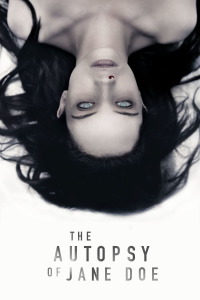
Is there anything better than a feature film of your predilection to catch you unprepared? Personally, I don't think so. Such awe has been experienced by a considerable portion of fussy cinephiles who attended the screening of a contemporary gem that came out of the Sitges Film Festival, from where the only offers worthy of consideration flow out in the genre. Winner of the Special Jury Award at the last edition of the festival, "The Autopsy of Jane Doe" is the brand-new ambrosia of the filmmaker who gained universal distinction seven years ago with an improvement of the currently infected mockumentary or also known as found footage with "Trolljegeren". Øvredal is called the author of this authentic and delirious movie, an idea originated in James Wan's "The Conjuring" film premiere. What a sublime work to conceive of his aspiration! but why did this modern classic inspire him? The horror stories of yesteryear will always be in vogue. The director talked to his representative ipso facto, who with successful selectivity obtained the screenplay by Ian B. Goldberg and Richard Naing, about a woman whose corpse shows no vestige of violence or contusion, dead as if by magic.
The story in question takes us to the basement-morgue of the Tilden family: an old man and his son, two coroners who spend days inquiring into the justification of the death of thousands and thousands of lackadaisical and whitish organisms. However, the consanguineous tradition, guarded by vile death, will be intercepted by the goals of the young man, fantastically performed by Emile Hirsch, about wanting independence from his father and forging his own path. While Tommy is looking for the right way to inform his father about his desires, the sheriff unexpectedly bursts into with an unscathed female corpse found at the scene of a crime in Virginia. Father and son initiate a detective journey to know the cause of her death, stumbling upon endless unnatural inconsistencies that trigger in a manic game of cat and mouse, only here cat is dead (literally).
I miss the time when an interesting story, an exceptionally gifted and a perceptive director was enough to make a horror film with possibilities of becoming a classic. And that is how many of the film summits are forged, movies whose exclusive pretense is to portray the malignancy while simultaneously elevating with formidable simplicity our cortisol levels, in other slang, spend a creepy pleasant time. Now, that vintage horror hasn't disappeared today, at least in form, since there are millions of remakes, reboots or other kinds of modernizations that big film studios produce about those feature films whose 80 minutes were more than enough to purify and amuse, nothing more, nothing less. However, in treatment and essence, only an indie directors clan and a negligible number of commercial filmmakers manage to retake these old-time techniques and paces by giving them a luxuriant, intelligent and equally terrifying stamp. So André Øvredal joins this restricted list with a necropsy to evil.
The film handle with care a progression of radically impracticable features in the field at present. It's a formidable elaborated horror experiment that benefits from Brian Cox's and Emile Hirsch's compatible performances as Sherlock and his fellow, a relationship both paternal-filial and medical-labor that leads with fascinating affability the thread narrative, promoting that the characters get along with audiences in the almost excellent first half of the story.
This is a sample that a solid tale, narrated in a successful way, doesn't presuppose pompous visual effects or crazy twists. It's a new trend provided by the overwhelming indie movies, which are numerous in quantity but with little recognition, movies hardly earning a few dollars at the box office or even have the honor of getting an imperceptible presence in theaters. Classified as "art cinema", Øvredal's work was truly electrifying to me, not as indie one, it had the facade of a work at the hands of a low-budget film studio, with properly American twists and conclusions but with developments, strangeness and stimulating resolutions capable of generating stupor.
It's a first rate mise-en-scène, a master class, benefiting from the oppressive dismal sets, plus incidental musicality, atmospheric shots of the lacquered wooden corridors, the metallic edges of the morgue or the outdated and gloomy elevator. It's worthy of a glance of Alfred Hitchcock due to the control of tempo, tempered and disturbing pace, the meticulous suspense use, the creaking in the neuropathological autopsy that provokes a certain discomfort in our heads, evidencing phenomenal sound editing and indisputable effectiveness transmitting sensations. Gradual info revelation and unconscious ignorance by the audience conjure a work starting with diplomacy and finishing consistently. Space manipulation deserves its own section, without doubt, one of the best achieved aspects of the whole film, using mirrors, shines, chiaroscuros, visual distortions, blind spots and above all opacity in order to make assistant's hair stand on end, unprepared people with the conception that they would witness pig's breakfast. What a surprise!
Unfortunately, it's not entirely perfect and in the ending, we feel a certain hesitation, symbolizing the confusing narrative conclusion, a double-edged sword, in addition, it doesn't detach from clichés and unjustifiable scares in the genre, however, they're bearable but frustrating. Just imagine you're embedded in the remotest darkness, but, you're not the only one in the place, you have the pleasure of having as companions to six corpses that are no longer within their corresponding cold rooms, you glimpse in the black mess that everything is upside down and in the middle of the scene lies a woman as pale as snow, unleashing unimaginable horrors, but suddenly, you spin around and a face with a mouth sewn shut catches you by surprise. Just disappointing. How you can have so much, and then nothing. Additionally, the film takes certain permissions such as inexplicable operation of broken bulbs, apparitions and fog fading according to convenience or dissipation of flames in the morgue, however, just as the jump-scares, these are tolerable.
"The Autopsy of Jane Doe" cleverly uses as McGuffin the lady who gives name to the film, meanwhile, Øvredal performs us a satisfactory autopsy on the most frightening fears that are on our minds as parasites, which can be synthesized with two succinct words: the unknown. We know absolutely nothing, the only thing we know for sure is that, at any moment, this pendulum of situations can break down. A story with an uncertain ending, but it executes an author film worthy of dithyramb, a work annexed to the best of the last years in terms of horror, a grand guignol proposal as electrifying as unexpected with an exciting 80's aroma that leaves no one indifferent.
This review of The Autopsy of Jane Doe (2016) was written by Kevin F on 21 Jul 2017.
The Autopsy of Jane Doe has generally received positive reviews.
Was this review helpful?