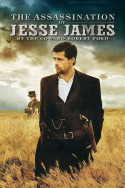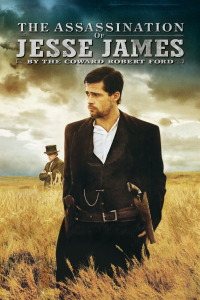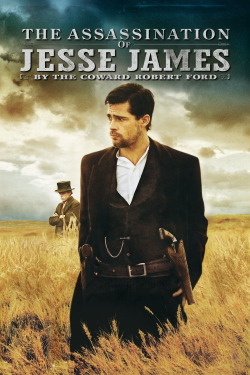
Review of The Assassination of Jesse James by the Coward Robert Ford (2007) by Gabriel P — 28 Sep 2012
We truly live in the age of the dead Western. The stilted, gritty revival of late has done its intended part to rejuvenate interest in the once-great frontier, but to call No Country for Old Men, There Will Be Blood or The Three Burials of Melquiadas Estrada true Westerns is to clutch at straws â" hell, Hollywood hasn't seen a pure original of the genre since 1992's Unforgiven, and even that showcased those modernist tendencies of today's cowboys. Mumbled dialogue, vociferous profanity, oceans of blood and more prostitutes than the Italian Parliament are all part of the rebranding. John Wayne's time in the sun has long since passed, but this begs the question; who will tell the story of the founding of the United States? Who will honour the lives of those who bravely went into the unknown? The Assassination of Jesse James by the Coward Robert Ford could be the answer.
In a damp birch forest in Blue Cut, Missouri, with twenty-odd scruffily dressed, malnourished deadbeats lazing in scattered sunlight, the movie starts with that awful feeling of dread â" it could go either way. Feeling the unstoppable sighs of âRoll out the bandwagon, it's another pretentious art-house Westernâ? building up inside, the characters then broke the silence in remarkable fashion. Sure, there's lack of diction and clarity, but the unusual phrasing, the stuttered pauses and the somewhat ponderous quality of the dialogue is thoroughly gripping; more postmodern than simply 'modern', it holds a realism unmatched by the vast majority of period-piece scripts, which often falter in their not understanding the difference between those who are realistic and those who are all unfailingly mentally ill. In the case of Jesse James, however, a large number of the characters are both of these things. James himself is at first a simple violent criminal who later morphs into a paranoid maniac unable to control his emotions, and Robert Ford, once a dough-eyed post-teenage fanboy, soon develops an near-romantic obsession with James, which, whilst teetering close to crossing the line of gimmick, actually aids the narrative no end. Watching Ford sat in a rocking chair in strained silence, struggling to hold back his tears as he realises he has to murder the man he loves, makes for challenging, heartbreaking viewing; the grandiose gestures and sly one-liners are a distant dot on the horizon as James goes crashing to the floor.
In taking a further step forward than its contemporaries, The Assassination of Jesse James has unwittingly rediscovered what it is that makes a Western great. Once again, cowboys can be human - they can shed tears, they can be cowardly, and most notably they can show love, romantic or not, to one another. Like John Ford's Westerns of the Golden Age, the protagonists, even if unlikeable, can bond in more than a buddy-movie, hard man way. This release refuses to be hemmed in by perceptions of what is 'cool' and what isn't, and it harks back to time long before the Spaghetti Westerns' shameful faux-'revolution' where any man with a gun was automatically too macho to show any emotion; it was all squinted eyes and grumbling monotone, and The Assassination, without meaning to sound crass, is a true revival of pure innocence. Think the married-couple-styled bickering of James Stewart and Walter Brennan in The Far Country. To this point, Andrew Dominik's script allows (with tremendous help from Pitt and Affleck) James and Ford's relationship to be studied in full detail, and though both men are murderers and criminals, it doesn't put its moral obligations at the fore â" it doesn't tell us who we should root for, nor does it suggest we should want either of them to die. We all know how it's going to end, and though our protagonists often act as if they do too, the story still hits with unexpected emotional complexity. In fact, this interpretation of the age-old tale almost acts as a vindication of Ford, whom folklore long since branded a 'coward'. The later scenes depicting his inevitable, crushing guilt are plaintive and melancholic; instead of James being the be-all and end-all of the story, we're reminded that the assassination cost Ford more than just an old colleague â" it stole his life from him. Despite his countless murders, train robberies and assaults, Jesse James, in death, became a hero of legendary status, and in his insufferable time on Earth, Ford became Public Enemy Number 1 and, taking the hatred with him to his grave, he remains the villain of the piece to this day.
Few films on this Earth have no flaws, and Jesse James isn't one of them. Though it feels necessary in order to cover all bases, at 160 minutes the movie is notably lengthy, and at times the costume design straddles the line between 19th Century cowboy and vintage-tinted Dalston hipster. Let me tell you though, this is the first film I've sat through in aeons where none of this matters. To be so sucked in by a film, so involved in its infrequent highs and gloomy lows, is to really appreciate a glorious, wondrous piece of cinema, a sorely unappreciated masterpiece of technical and emotive dexterity, a real gem, a purist-pleaser of the modern Western movement. With the help of Roger Deakins' sweeping, beautiful bluegrass plains and claustrophobic scenes of trains screeching to a halt in the night, the beauty of the bleak Western is back, and back with a bang. At once painful, epic, sprawling, moving and awe-inspiring, The Assassination of Jesse James by the Coward Robert Ford stands tall as a giant of the genre, one of the most emotionally affecting films of the last decade.
This review of The Assassination of Jesse James by the Coward Robert Ford (2007) was written by Gabriel P on 28 Sep 2012.
The Assassination of Jesse James by the Coward Robert Ford has generally received positive reviews.
Was this review helpful?