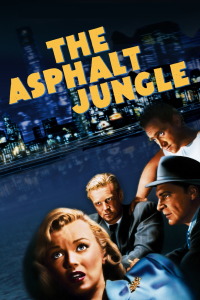
Review of The Asphalt Jungle (1950) by Issac L — 04 Sep 2012
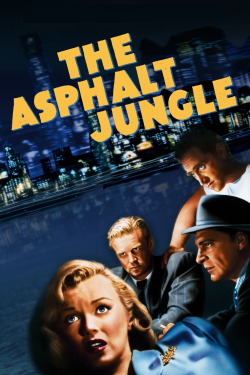
After two misadventures with Hustonâ(TM)s more recent films PRIZZIâ(TM)S HONOR (1985, 5/10) and THE MAN WHO WOULD BE KING (1975, 5/10), I turned to his earlier canons to find some redeemed compensation, THE ASPHALT JUNGLE, a Black % White film-noir, scrupulously delves into the ramifications of a bank stick-up in the 1930s depression period of America, which is executed by a slew of criminals whose ill-fated predestination will indubitably resonate after 60 years, since fortunately we havenâ(TM)t been evolving much and its neo-realistic aesthetics is still sitting comfily in the appreciative zone.
For me, since I am oft more intrigued by the narrative arc than the comprehensive mise-en-scene a director concocts (at least in this present period), the film excels itself in founding its empathy on several well-depicted characters. Sterling Hayden, the first-billed star of the film, equivocally the leading man among the motley crew, is not the brain, but a trustworthy hooligan, suitably amplifying his simplistic kindheartedness by exposing himself to his girl friend (the moderately-used Jean Hagen) of his stroke of bad luck and his humble-but-never-realized dream (which Huston cleverly opts as the heart-rending culmination) under the veneer of his stalwart physique.
Sam Jaffe, who acquired his one and only Oscar nomination (the film altogether got 4 nominations including a BEST DIRECTOR for Huston) for the role of Doc, the constantly behind-the-wall mastermind, has another sort of fatalistic empathy through his non-violent, genteel policy which is simply the otherness for a perpetrator, he is a born leader, who welds a collection of gifted offenders into a real team, the only thing he misses it luck. Louis Calhern, the paymaster and the fence, ostensibly well-off, but bankrupted, is the major mis-step of the heist, Calhernâ(TM)s commonly understated performance finds the right place as he is juggling between his wife and his trophy mistress (a 24-year-old Monroe, whose striking sheen cannot be overlooked even in such a minor role).
The film is feasibly an agitprop of police department, although the coppers are neither over-beautified nor disparaging represented (unlike the present mockery trend), it emits a pertinent point-of-view of their functions and liabilities, Huston is the torchbearer of the American neorealism, and I hope this assertion can stand its ground.
This review of The Asphalt Jungle (1950) was written by Issac L on 04 Sep 2012.
The Asphalt Jungle has generally received very positive reviews.
Was this review helpful?