Review of The Act of Killing (2012) by Natalie M — 08 Feb 2014
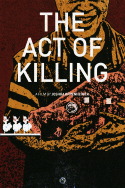
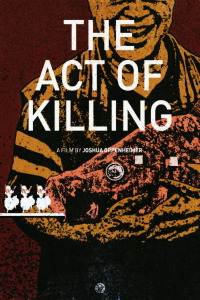
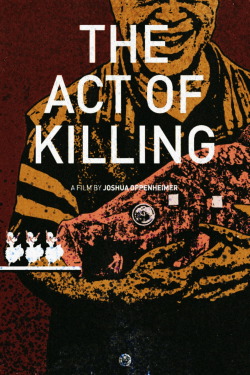
One of the most surreal films I've yet seen, Joshua Oppenheimer's "The Act of Killing" is a revelatory look into the soul of the world's fourth most populous country.
On one hand, I felt a bit manipulated, as is the risk with documentary cinema. I'm not saying there was anything like mistranslation or anything, but I felt more than a little guided on this journey. I am hungry for an objective counter argument.
For those unaware, premise is that members of the Indonesian government's gangster death squad are allowed to tell their stories cinematically in the style of their favorite Hollywood genres. The film then goes on to show some of the unfinished production footage. A con is that the director's cut goes almost overboard with the amount of the mock production footage it shows. But to be frank, the premise of having the killers make films in the style of their favorite Hollywood products actually takes a back seat to the real issue of the film: the state of the contemporary Indonesian government. It may or may not be as modern as we perceive it, despite the towers in Jakarta.
The film is a profile of the assortment of tactics and moral definition the current Indonesian state descends from, more specifically the rationale of right wing death squads bent on exterminating "Communists" in order to preserve the status quo. When questioned on the rationale, the members mainly said that they did it and described the political conditions surrounding the nation at the time, i.e. tension building between the military and the Communist movement. There may have been some statements as to the morality of their actions, but the main subject, Anwar Congo, primarily described his practices in vivid detail, while attempting to compartmentalize the haunted feelings that linger.
Imagine if the Nazis won WWII in Europe and the SS and Gestapo got away with their actions without meaningful repercussions. Then imagine a film profiling their life musings and proposed interpretations of the Holocaust in the style their favorite French operas or something similar. Besides this film being focused on a more culturally distant Pacific nation, rather than the heart of Western Europe, the fundamentals at the human level are equivalent.
In a contrast to the industrial efficiency of the Holocaust, these guys did it old school. They made do with some simple low cost methods. They successfully completed a manual genocide of the ethnic Chinese and purge of alleged communists with only some wire and elbow grease. The brutality and crudity is staggering. The paramilitary gangster-ish group, the Pancasila Youth, that the main subject helped found, might as well be the Hitler Youth. Its nationalism and lack of qualms regarding the use of force are equivalent. No mention is made by the members on how these actions violate several of the founding Pancasila principles, after which the paramilitary group profiled in this film is named, including civilized humanity and social justice.
Though despite that brutality, the main subject is a human being who loves film and bowling. He even displays some vanity as the film shows him fiddling with his false teeth before every major film shot. He also dyed his grey hair black for the fictional film scenes. He has these standard human traits, but he's also murdered hundreds of people under a insubstantial political justification. His colleagues are the same. They occupy different points in the human spectrum when viewed in isolation, but aren't in the image of evil alien machines, despite their records. Hannah Arendt's oft cited 'banality of evil' applies here.
The fact that Congo is free to roam and celebrated still yet, even after his past is common knowledge is a blunt point of contrast between a country like Indonesia and others in the West. Similar figures in the West tend to (or so we think) get thrown in prison or executed after a comprehensive character assassination. Folks from the Yugoslav conflicts come to mind, even if some of them died before seeing justice.
My eyes are opened not only on the present status of Indonesia, but likely most authoritarian states in the developing world. The Pancasila Youth and their past are only a symptom of the corrupt government structure that took root. I would like a counter argument, but goodness, this hard to watch film is essential viewing for anyone with an interest in the late life evaluations of a death squad leader or the moral tolerances of corrupt authoritarian states in general. One can probably insert just about any dictatorship in the place of Indonesia, it's probably more widespread than people realize. (29 January 2014).
This review of The Act of Killing (2012) was written by Natalie M on 08 Feb 2014.
The Act of Killing has generally received very positive reviews.
Was this review helpful?