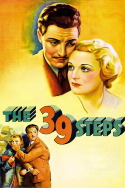
Review of The 39 Steps (1935) by Blake P — 07 Apr 2015
What are the 39 steps? we ask ourselves at a near constant pace during "The 39 Steps". Unlike the ambiguities of "The Birds" or "Suspicion", we do eventually find out the answer to the question that so harshly eludes us. But like "The Birds" and "Suspicion", we have a director at the front of the film that makes us care about the answer. If it was devoid of its smart suspense, surely the results would not be so startlingly entertaining. "The 39 Steps" comes fairly early in Alfred Hitchcock's lustrous career, arriving in 1935 (keep in mind his last movie was released in 1976) and acting like a sample of the more assured wronged man/chase movie/adventure romps of the Master of Suspense's future. I was reminded of later masterpieces, like "Saboteur" and "North by Northwest", two wronged-man on-the-run actioners that slid along with electric thrills and winking humor that felt at ease in the tense atmosphere.
Robert Donat portrays Richard Hannay, a young man confronted with murder and intrigue at a rate most normal folks would faint at. One night, Hannay attends a sideshow highlighting "Mr. Memory" (Wylie Watson), a performer with startling memorizational abilities - ask any question (besides a personal one), Mr. Memory will know the answer with the detail of a much tended to Wikipedia page. Hecklers attempt to damage the wonders of the scene, but just as things are beginning to turn around, shots are fired, causing a massive panic and the thud of a dead body. Hannay finds himself comforting an attractive woman, Annabelle Smith (Lucie Mannheim), in the midst of the ruckus. He takes her back to his flat in sympathy, but just because it's 1935 doesn't mean that some people aren't hoping to get just a little bit lucky.
Before anything can happen, though, Annabelle reveals her true motive - she is not just a woman who trusts that men will take her back to their apartment and not try anything questionable; she is also a spy who is being pursued by deadly assassins. You see, she has just discovered a wicked plot to steal important British military secrets. Why she is foolish enough to tell all this to a bystander she only met a few minutes ago I don't know, but here's where the plot kicks in: she (a) mentions the 39 steps (but doesn't include its meaning!), (b) warns that the mastermind behind the entire plot is missing the top joint of his finger, (c) is murdered, and (d) leaves Hannay not only confused but also wanted for her murder. So he goes on the run, and throughout the course of his unwanted adventure he finds out what the 39 steps actually are/is, meets the man who probably has a difficult time handling a pencil, discovers who offed Annabelle, and teams up with a blonde (Madeleine Carroll) who acts as his love interest and sidekick.
Truth is, Hitchcock has made plenty of movies that bear similarities to "The 39 Steps" (he can't get enough of wronged-men and sophisticated blondes), but our inhibitions are nonexistent because this is a Hitchcock movie, for crying out loud. Even if many of his themes and characters could pass for brother and sister, there is never a feeling of repetition in his films. As one of the best (and most inventive) directors of all time, he is never lazy, always devising new ways to fondle the camera, finding the fun in actors and their characters, making them people we can root. It's impossible not to remember a specific shot or a specific character in his films considering they all feel so utterly distinct.
"The 39 Steps" is perhaps a seamless example of Hitchcock's genius. It's uncomplicated, totally enjoyable fluff, but like all of his films, there is a harmonious relationship between unaffected escapism and true art. The plot moves along with remarkable speed, resembling a roller coaster ride or an old-fashioned adventure film in the same mindset of "The African Queen" or "King Solomon's Mines". But the punchiness would simply not work if not for Hitchcock's extremely deliberate attitude towards his camerawork and his storytelling. Take, for instance, the scene in which the first murder takes place: the crowd, heckling their brains out, are almost a single body, one big ball of sassiness. But when the gun is fired, it isn't just some random noise that interrupts the situation. Hitchcock skims around the entire group of people, defining them as a large mass. Then, suddenly, he cuts to the hand that shoots, sending the room into a frenzy. A quick move like this only builds the suspense. It gives an impression that in any setting, even a sideshow act where things seem safe, there is always some sort of faceless threat, establishing our, and the leading man's, paranoia. We can laugh at the wit that we're faced with near constantly, and we can sweat bullets all we want at the sight of a villain, but never do we feel completely at ease. Other quirks, such as keeping the mugs of the men who eventually kill Annabelle far away but dangerous, keeping a close-up on Donat whenever he enters a situation where he may or may not be recognized, heighten the giddy thrills Hitchcock magnificently creates.
Donat is wonderful, and so are Carroll and the writing, but "The 39 Steps" is more about Hitchcock than anyone else. It is, perhaps, the film that started it all. It began the legend of the macabre adoring director just as much in love with entertaining audiences as he was with his camera and his thoughtful manipulations.
This review of The 39 Steps (1935) was written by Blake P on 07 Apr 2015.
The 39 Steps has generally received very positive reviews.
Was this review helpful?