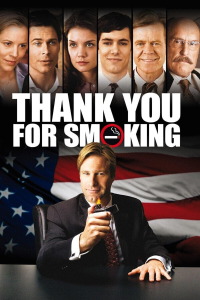
Review of Thank You for Smoking (2005) by Paul Z — 25 Jun 2010
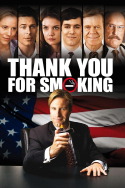
Here is a lampoon both slashing and refined, a dart rather than a bullet. Thank You for Smoking aims at the pro-smoking lobby with a bleak admiration for human nature. It stars Aaron Eckhart as Nick Naylor, a spokesman for the Academy of Tobacco Studies. We meet him on The Joan Lunden Show, sitting next to a chemo-ridden 15-year-old boy dying of cancer, but has stopped smoking. Nick steps gracefully up to the plate: "It's in our best interests to keep Robin alive and smoking," he explains. "The anti-smoking people want Robin to die." Nick Naylor is an upbeat, suave career lobbyist who is divorced, loves his son Joey (Cameron Bright, who seemed to be in a good cluster of movies between 2004-06 before just evaporating) and addresses the kid's class on career day. "Please don't ruin my childhood," Joey begs, yet his dad gives a little girl the third degree whose mother says cigarettes can kill you: "Is your mother a doctor?" Once a week he eats with the MOD Squad, whose other affiliates are alcohol lobbyist Mario Bello and firearms lobbyist David Koechner. They debate over which of their products kills the most people. It always makes me laugh because one always wonders who would be these people's friends? Each other, most likely.
The movie was directed by Jason Reitman, then 29. It is his least successful so far, but his best so far. What's most impressive in his first feature is his mastery of pitch. He conveys a particular impartial reasoning to his approach, such as how Nick arbitrates with Hollywood producer Rob Lowe on the question of how to get movie stars to smoke on screen again. Nowdays, they concur, no one smokes in the movies save for villains and Europeans. The stars would have to smoke in historical pictures, because in a contemporary film other characters would invariably be asking them why they smoke. Or, why not in the future, after cigarettes are better? Smoking in a space station? Reitman's father directed Twins, Dave and the Ghostbusters films. However junior has his own M.O., subversive and downplayed. Rather than occupying his movie with people smoking and coughing and wheezing, he presents not one person smoking, except Robert Duvall's antiquated Captain, kingpin of the tobacco industry, who sports a cigar more like a pistol than a luxury. Instead, the film's delightful soundtrack harks back to popular hits that glorified smoking in the 1940s, '50s and '60s. And Eckhart is beaming, upbeat, and even confiding. He's not incapable of being taken advantage of himself on occasion; he's just resilient when that occurs.
Based on a novel (written by no other than Christopher Buckley, the Obama-supporting son of poster-boy Republican William F. Buckley), Reitman's own screenplay keeps the erudite tang. I greatly appreciate the film's sense of form. Nick Naylor is not pompous or vainglorious so much as an impartial witness of his own grandeur. It is the movie's intention to humble him, but he never stoops, even in an especially tight pickle still relying on his proficiency at spinning anything to his advantage. His antagonist in the film is William H. Macy, a Vermont environmentalist Senator whose office desk is populated with all his hoarded maple syrup bottles. The senator has proposed a bill ordering a skull and crossbones to be put on every cigarette pack, usurping the government health warning. The insignia is superior to the words, he says, as "They want those who do not speak English to die." The film's inflection is so adept that it can even make a villain out of a politician who's actually doing something about public health and environmental safety. And the movie does it tastefully even.
Should the movie be more biting? Many have lost their lives to cigarettes while many others, including myself, smoke themselves silly, though it's unlikely that more vitriol would better it. All smokers and non-smokers know cigarettes can kill you, yet they stay purchasable and make billions of dollars in taxes. Ground zero of the movie is not nearly as much tobacco as lobbying altogether, which along with advertising and spin-control makes a vast assortment of affliction and decay tolerable to the people. You can discern when something is not good for you by the amount of work done to persuade you it is innocuous or favorable.
This review of Thank You for Smoking (2005) was written by Paul Z on 25 Jun 2010.
Thank You for Smoking has generally received very positive reviews.
Was this review helpful?