Review of Tetro (2009) by Eric F — 18 Jul 2009
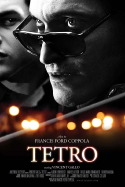
Francis Ford Coppola cemented himself long ago as one of the most influential of all modern directors. He's stumbled a bit since "The Godfather" trilogy and "Apocalypse Now", releasing works like "Jack" in 1996, but he now returns to the screen with a film written by himself. It's a deeply personal story, filled with guilt complexes and family feuds (despite him claiming that "nothing in it happened, but it is all true"), and it's had a modest limited release due to it's low budget. While it's not a great film, especially as it carries the baggage of expectations that is the Coppola legacy, it's still a remarkably fresh and exciting feature to see on screen. Does it all work? No. But when was the last time you saw "Faust" performed in drag in beautiful black-and-white cinematography? Had this been the work of a new director, he would have been praised as a visionary. As it is now, it stands as a vague and minor work from the prolific director. But, hey - we're far from "Jack" territory.
After running off from military school, 18-year-old Bennie (Aiden Ehrenreich) finds himself working as a waiter on a cruise ship. When the career takes him to Argentina, he takes advantage of the opportunity to catch up with his brother, Tetro (Vincent Gallo). Tetro's an unpleasant fellow - after accidentally killing his mother in a car accident and running away from his father (Klaus Maria Brandauer), he's been reduced to a bitter shell of his former self. The only person in his life is Miranda (Maribel Verdu), his lovely and oddly supportive girlfriend whom he met as a patient of a mental hospital.
The first half of the film is a bit of a familiar melodrama. Bennie searches through Tetro's things while he's out, and a friendship between Bennie and Miranda leaves Tetro suspicious. Bennie constantly presses for answers, and Tetro continues to resist. Then, however, following an accident - things move along in entirely new directions. Bennie creates a stageplay of Tetro's unfinished novel, and the response is so positive that it wins a spot in a prestigious arts festival. Tetro shows up during the awards ceremony and the family secrets are revealed in what has all the makings of an epic climax.
Unfortunately, however, by that point i'd long since given up on the characters. Miranda, who was perhaps the most interesting character in the developing moments, is largely abandoned. Bennie and Tetro start acting in ways that seemed uncharacteristic of both, and their transformations happen so rapidly that it becomes ludicrous to buy. The last act is exhausting - not for the extraordinary release in dramatic tension, but because the film had long since run out of steam.
Despite the emotional disconnect and implausibility of the narrative, however, it's undeniable that this is an absolute treat to see in a theater. The cinematography is gorgeous, and Coppola is able to pull off these fairly pretentious "color" sequences of opera (even, at one point, showing a whole sequence of "Tales of Hoffman") with an elegance that we play along with against our better judgement. It's a visual spectacle, an absolute feast for the eyes. But as gorgeous as it is, it's perhaps a bit too vague and convoluted to leave a lasting emotional impact.
This review of Tetro (2009) was written by Eric F on 18 Jul 2009.
Tetro has generally received positive reviews.
Was this review helpful?