Review of Tetro (2009) by Mark C — 06 Apr 2011
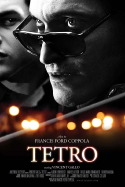
"Tetro" is a film that comes along and breaks expectations and has fun doing it. If you're in for the ride, you're immersed. Coppola writes this story, 35 years in the making, that is akin to a grand opera. It is an "Opera-comique" (Coppola hints at the association in many ways) in the fullest sense with a very expressive nature, uneven tone, and tragic proportions.
It's so clearly a personal story for the filmmaker. It's painfully beautiful. The characters are well-written and so fleshed out. I felt an instant connection to them all. They aren't all wrapped up nicely. The film gives us enough background to relate and empathize, but never to fully understand. This is a feat for any writer. The material is so immense, I felt the film could have been an hour longer. What's touching is that it's ultimately an optimistic.
What will first grab the audience is its stunning visuals. There isn't a single frame that isn't thought out to perfection. "Tetro" exemplifies the potential of digital in a huge way. The style is very modern and classical at the same time. What's interesting is Coppola doesn't move his frames. They are often static, letting the characters move in and out of them. There's a fixed state which works so well with the story. I can't explain the look of this film. It is new and old, fluid but stationary, expressive but subdued.
This could be the best edited film of the last decade. The master, Walter Murch, always triumphs with Coppola. The images flow in a flawless manner. The frames are beautiful, but Murch leaves them up long enough to absorb, but never to indulge in. There are some cuts that hold up to the days of Eisenstein - with Coppola's tongue-in-cheek juxtapositions. I never thought he could top (what I think is the best edited film) "The Conversation". It is visual poetry.
I find it ironic that I'm even critiquing this film. For this is the second brilliant (The first being "Ratoutouille") film I've seen this past decade that doesn't want or need praise. It criticizes...well criticism. Coppola has faced much criticism these past decades. And rightfully so. Later in his career, Coppola started going backwards, creatively, following in the vein of master painters like Picasso or Magritte. He started playing around with his craft. He started trusting his instincts. "Tetro" pays homage to the instincts of the artist. As we follow Bennie through this film, we understand that this can often be very dangerous...but also, very rewarding.
The film resembles, to me, a great jazz piece. In that it throws everything into the mix (it's a romantic, dramatic thriller with comedic punches), it improvises beautifully and each instrument can go off freely because the spine of the film is so sharp. The story of "Tetro" enters realms other films only dream of entering. As a written piece, it's thick. It runs on all cylinders, in its philosophical, dramatical, psychological, and sociological elements. This is a mature work, with a childishness about it.
"Tetro", like the European cinema in the sixties, is what I would call a calculated risk. It's sharp, witty, satirical and painstakingly beautiful. But it's, nonetheless, a risk. It's a risk in that it says things about its characters which often aren't said. It devalues fame and fortune. It denounces the power of the audience. It visually burns those influences which came before it. But in that, it accepts its new path. The path may be blinding and dangerous. But I can safely say, Coppola isn't alone on it.
This review of Tetro (2009) was written by Mark C on 06 Apr 2011.
Tetro has generally received positive reviews.
Was this review helpful?