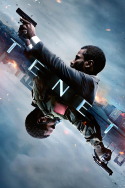
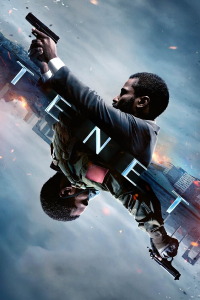
Review of Tenet (2020) by Bertaut1 — 30 Sep 2020
An aesthetic showcase that's uninterested in human beings (and what does Christopher Nolan have against decent sound mixing?).
In Tenet, Christopher Nolan is again examining the vagaries of time, a theme that's front and centre in much of his previous work. It's undeniably fascinating to see a tent pole Hollywood production engaging with issues such as entropy, thermodynamics, reversibility and irreversibility, the grandfather paradox, and T-symmetry, but the film's main problems are more fundamental, existing almost entirely at a structural level (although some of the performances don't help, nor does the abysmal sound mixing). It looks incredible and the practical effects in the action scenes are extraordinary, but there's nothing of note under the shiny veneer. It's a film with no interest in human beings.
The plot is straightforward in outline. We follow a CIA operative known as The Protagonist (John David Washington) as he is recruited into an ultra-secret international espionage squad called Tenet. His mission is simple – at some point in the future, someone has figured out how to reverse the entropy of objects, effectively being able to send them back along the timeline without having to reverse time itself. The implications of this are catastrophic and have set humanity on course for World War III, unless The Protagonist can figure out who is doing it and put a stop to their machinations.
Tenet is an event movie in every way; this 150-minute, $200m+ original idea is a massive studio tent pole written and directed by the most popular filmmaker alive. And I will say this, the budget is on the screen. No small amount of that money, of course, went on the practical effects (incredibly, there are only 280 VFX shots) – whether it be bungee-jumping onto the side of a building, a close-quarters fight where one of the combatants moves in reverse, a Boeing 747 jet crashing into a building, a highway chase where some of the cars are going forward in time and others are going backwards, or an all-out battle scene where, again, some of the soldiers travel forward whilst others move in reverse.
Along the same lines, the cinematography by Hoyte van Hoytema is stunning, as he mixes 15-perf 70mm IMAX film with traditional 70mm stock and a few 35mm sequences in a manner where the shifts in aspect ratio are barely noticeable. It's the kind of film that could only exist in the medium of cinema – no other artform could even begin to approximate its aesthetic design and splendour. A celluloid purist, Nolan has always made a big stink about the artistic importance of cinema, and Tenet finds him pushing the aesthetic boundaries of what the artform can accomplish.
Unfortunately, no matter how visually unique or aesthetically impressive it may be, no amount of gloss can hide the fact that the screenplay suffers from some fundamental problems – most notably, it's bereft of emotion and populated with cardboard cut-outs that are supposed to be characters. The Protagonist isn't a person with an interiority; he's a cypher, the audience's surrogate so that Nolan can explain the plot to us. He's emotionless, void of relatable motivation, has no psychological through-line, and nothing even resembling a character arc. As for Kenneth Branagh as Russian oligarch Andrei Sator, he might be the most cliched Russian villain ever put on screen. He isn't a person – he's a collection of near-satirical tics, clichés, and elements from other, better films.
As Kat, Sator's trophy wife, Elizabeth Debicki fairs better, but her role is still poorly written. A common criticism of Nolan's filmography is that his female characters tend to be victims. I'm not saying that Nolan is obliged to write more rounded female characters. Much like Michael Mann, Nolan's films are androcentric. And there's nothing wrong with that. However, in Mann, there are strong female characters with considerable agency, whereas in Tenet, Kat is nothing more than a pawn who's defined almost entirely in terms of her role as a self-sacrificing mother.
At one point early in the film, The Protagonist is told "don't try to understand it, just feel it", which is advice that Nolan is also offering to his audience. The problem is that there's nothing to feel. Unlike Memento (which remains Nolan's best by a long way), which packed a seriously emotional gut-punch when we learn what's at the heart of the puzzle, Tenet offers us nothing more than the task of deciphering it for its own sake. There's no payoff, nothing to make us want to penetrate a story uninterested in depicting real people or real emotional stakes. More enamoured by the complexity of its own design than by any of the people contained within, it's an emotional void – all technical virtuosity and surface sheen with nothing at its core.
This review of Tenet (2020) was written by Bertaut1 on 30 Sep 2020.
Tenet has generally received positive reviews.
Was this review helpful?