Review of Tekken (2010) by Harry W — 23 Nov 2014
Based on the fact that Tekken is the greatest fighting game series I have ever played, as wrong as it was, I had high expectations for the Tekken film adaptation.
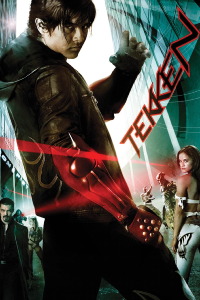
The problem with Tekken is precisely how much it defies the universe of the video game series. The universe is huge with over 6 games of storylines for its huge collection of characters, and I couldn't expect it to tell the story of every character. I pretty much assumed that it would tear them all down to the most basic of character elements and turn them into strictly the gimmick of a series of characters that protagonist Jin Kazama would go up against. I hoped that the film would at least put some level of understanding into the background of Jin Kazama while emphasizing his history as part of the Mishima family. Unfortunately, even that was too much to expect. Every single character in the film is reduced to being a simplistic gimmick. I don't care so much that the Tekken universe is overly simplified simply so it can focus on getting everyone into battle, but the fact that the film fails to do anything with the high concept potential of its characters is wasteful. Dwight H. Little insults fans of the series everywhere by disgracing their characters with overly simplifications of every little element about them. I can handle the weak and generic script as well as the lazy plot, but Tekken is a $30 million project and you would think that hiring characters who actually look like who they are playing would not be too hard. Apparently it was.
From a narrative perspective, Tekken fails all because of how it characterizes Jin Kazama. It turns him into a generic hero with a confusing reason why he is truly competing. He is portrayed as an underdog fighting for his dead mother while maintaining no sadness for her loss and getting over it pretty quickly. A generic element in underdog sports movies is the fact that during a fight when the hero begins to falter, he or she is suddenly inspired by either someone in the audience or some flashback. With Tekken, Jin Kazama goes through this in practically every match. The gimmick wears thin excessively fast and just gets annoying in no time. It is repetitive throughout all the fight scenes without ever making any kind of positive impact. There is one out of five of his fight scenes in the movie where he does not flash back to memories of his mother, and this is his final battle with Kazuya. In it, he is getting destroyed until the last second where he does a single victorious technique. He doesn't rise from a fall, he just turns things around in a ridiculously unrealistic fashion. The film is nothing but a consistent series of semi-decently choreographed fight scenes and decent production values. This may entertain the most brain-dead action movie fans, but the fans of the series will find it insulting. Yet it isn't hard to ignore all that, what it is impossible to look beyond is how wrong the actors look and how they do minimal for their parts due to poor characterization.
The casting agents on Tekken got lazy because they failed to cast any actors who look much like the characters they are supposed to be playing. I can settle for the fact that the fighting style of each actor fails to match up to the level of skill that the source characters maintain, but their lack of relevant appearance is a breaking point for me, even if the costumes look slightly appropriate.
Jon Foo is way too mistcast as Jin Kazama. Despite looking Asian, he is an English actor who has simply Asian descent. His English accent shines through way too often and he doesn't look right enough for the part. In the games, Jin Kazama is so iconically Japanese that it is unforgettable. In the film, he doesn't have the right hair or the correct voice at all. And I won't get started on his limitations as an actor because, let's face it, acting is one of the last things you would expect from a Video Game adaptation of a film. His approach to the role is way too casual. As the lead character in Tekken, he fails to do anything for the part. He looks no better than he acts, and despite a half decent ability to throw a punch, he is incredibly wrong for the role of Jin Kazama which gives the film an untalented and generic lead.
Luke Goss looks absolutely nothing like Steve Fox with his energy limited to being a cheap parody of Jason Statham which is coincidental considering that he would later take over as the lead in Death Race 2 and Death Race 3: Inferno after Jason Statham took the lead in the first Death Race. He does not have the appropriate physical frame and he is bald which means he is bereft of the appropriate golden hair which makes Steve Fox memorable. He doesn't even dress appropriately, so the lacklustre appearance of Luke Goss massively overshadows the fact that his performance in the film is bereft of any charisma. But the fact that the film actually kills him off is the biggest insult of all. A film which kills characters who never die is just wrong.
Ian Anthony Dale fails to look any more Asian than Jon Foo, but he looks even less like his character than anyone else which is trly pathetic. His iconic hairstyle is not in the part, his face looks wrong and he could not be less Asian. Ian Anthony Dale fails to have any appropriate appearance whatsoever, and his acting contains not a single element of strong evil. He looks more confused than aggressive as well as maintaining a very incorrect appearance, and his tone of voice is just off. Ian Anthony Dale is the worst cast member in Tekken because he looks way too unlike the character he is playing, cannot get a grip on any dark spirit whatsoever or even deliver any charisma whatsoever. He is stuck with the worst lines of the script and delivers the worst performance of them all, making him the most sorry excuse for an antagonist. Ian Anthony Dale is the most prime example of miscasting in Tekken, and his lack of acting skills play second fiddle to his wrongful appearance.
You'd think that the presence of Cary-Hiroyuki Tagawa in the role of Heihachi Mishima would be a brilliant move considering his legacy for portraying villains in kung fu movies, including the Mortal Kombat film as Shang Tsung. But the film gives a half-assed touch of makeup to him and characterizes him strictly as a frail and powerless old man. This is an insult to the game because many people have tried to destroy Heihachi Mishima countless ways, ranging from his son dropping him off a cliff to him encountering a massive explosion. Yet as any fan will know, The Devil Gene is what lays dormant in all the Mishimas which renders them very powered. In Heihachi's case, it renders him practically immortal, while in the Tekken film he plays such little relevance in the story. Heihachi Mishima cannot die, that is why he is such a strong villain for the game series. Yet the fact that the movie actually characterises him as nothing more than an old man drove me insane. Cary-Hiroyuki Tagawa cannot even do his thing in Tekken or get in on a single fight, so his presence is just wasted. It doesn't appear that he was able to do too much with the part anyway, but if he got even a single fight in I would have mild satisfaction. Alas, that is not the case.
Kelly Overton may look slightly like Christie Monteiro and be attractive enough In the part, but the fact is that she is playing a capoeira fighter. Her fighting style only has the most minor elements of Christie Monteiro while she goes for a more conventional MMA style of technique. Her fighting skills suffer siously in comparison to Lateef Crowder's whose far superior capoeira skills pay some tribute to the game series. Her acting is poor and her fighting is incorrect, but she does at least put up a semi-decent fight in her moment of truth.
Tekken neglects to mention the conflict between Nina and Anna Williams which was very important to characterizing them. In the film, they are used as a duo of assassins used to team up and fight the same enemy. In the games, the enemy was each other and they wanted to kill each other with a seriously violent passion. They are nothing in the film but supporting characters with little fight in them, and they remain wasted.
Even the Jacks look nothing like the Cyborgs that maintained an iconic design, although this is far less bothersome, and Cung Lee's cameo boasts him looking nothing like Marshall Law.
The battle scene between Eddie Gordo and Raven gives the film a good start because both actors look the part well enough and they both share a depiction of the fighting styles iconic of each character, particularly Lateef Crowder whose capoeira expertise makes him a strong casting decision for the role of Eddie Gordo. He looks the part really well, and Darren Dewitt Henson does too. These two actors are the only strong additions to the cast in Tekken, and since they play some of the most minimalistic roles in the film, that is a serious problem. Still, they make a memorable impact.
Anton Kasabov may not look perfect for the role of Sergei Dragunov, but his fighting style is pretty on par because he is good at what he can do with his kicks. Gary Daniels looks and fights decently in the role of Bryan Fury, and Gary Stearns does his part while decked out in a fairly cool Yoshimitsu suit.
So Tekken falters due to a poor story and weak script, but more so because the cast members all look inappropriate and none of them can act their way through a Michael Bay film, even if a few of them put up a decent fight during the action scenes.
This review of Tekken (2010) was written by Harry W on 23 Nov 2014.
Tekken has generally received mixed reviews.
Was this review helpful?