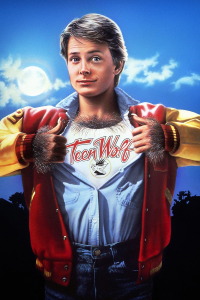
Review of Teen Wolf (1985) by Ryan V — 15 Oct 2011
I really don't get the '80s, culturally speaking. Pretty much any other post-war era of youth culture makes some relative, context-specific sense to me, as far as styles, fashions, values, and so forth. I may not enjoy those elements or find them "cool" (though that word itself is at the root of the problem), but they have a measure of general intelligibility, at least. The 1980s are unintelligible. I just have no idea how anyone could have possibly thought any of the fashions, music, or colloquial expressions were good or interesting on any level. And that same impression goes for a movie like "Teen Wolf".
I can acknowledge that Michael J. Fox, at the height of his post-Marty McFly fame (though not that far post, as "Teen Wolf" followed "Back to the Future" by a month and a half), has some undeniable aw-shucks appeal to bring to the table, to say nothing of the considerable reserves of flailing, frantic comic physicality he brings to the table. And there's something potentially inspired about burgeoning werewolfish abilities as a metaphor for puberty, especially when grafted onto the mid-80s' diminuitive prince of vanilla-white teenage everymanhood.
But "Teen Wolf" never gets there, for a panoply of reasons. The supporting cast - headed by an avuncular dad (the revelation that he shares his son's blessing/curse is actually slightly clever/unexpected), a wacky buddy, the nice girl and the manipulative girl, and a square-jawed antagonist - bluff their way through stock roles. The special effects are astoundingly bad, and the music is an ugly smear of synthesized pablum. Additionally, the basketball scenes are laughable to anyone with even a passing familiarity with the game's rules; I was shouting for a 10-second violation when Fox's Scott Howard transforms to his lupine self on the court and dribbles slowly backwards, but the ref ignored me.
Beyond this, though, I wonder at the film's thematic message about individuality and conformity. Scott laments being an average nobody before discovering that he's different and special, but the script has him choosing conformity over distinction in the end, because conforming and being "normal" is what it takes to be true to himself. This is complicated by the depiction of the school's enthusiastic reaction to his wolf self, however; assuming the animal identity is characterized as conforming to others' expectations of him, so he must choose to reject it in order to "be himself" (almost always the preferred end point in Hollywood films).
I could be wrong, but this strikes me as a very Reagan-era thematic value: individuality and excitement are to be discouraged. It's fun to be an uninhibited beast for awhile, but then you have to grow up and get a mortgage. There is no shame in conformity, and much less in the way of social dangers as well. Being an average nobody will set you free! That "Teen Wolf" upholds such values while embodying the sort of shiny mediocrity that underlies them makes it a relic of its baffling time, and not really much else.
This review of Teen Wolf (1985) was written by Ryan V on 15 Oct 2011.
Teen Wolf has generally received mixed reviews.
Was this review helpful?