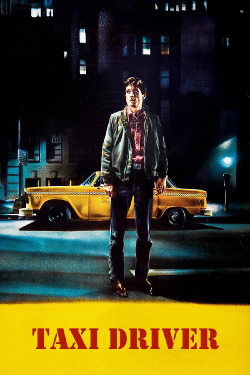
Review of Taxi Driver (1976) by James K — 25 May 2014
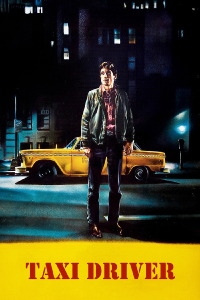
[Spoilers] "Taxi Driver" is a character study about Travis Bickle, a retired Marine who had served in Vietnam. The war left him with psychological issues, especially insomnia. To combat this ailment, he decides to take a job as a nighttime taxi driver in New York City. Due to a strong set of moral convictions, Bickle will allow anyone - from prostitutes and their clients to gun-toting gangsters - from the most dangerous parts of the city to ride in his cab. However, he becomes increasingly disgusted with his clientele, especially when he takes a married passenger to the house his wife is cheating on him at - he then declares that he is scouting the house while formulating a plan to kill her. In response to passengers like this, he purchases some guns and starts training to become a vigilante.
Meanwhile, Bickle becomes smitten with Betsy, a clerk working on the campaign trail for Senator Charles Palantine, a presidential candidate. Bickle demonstrates that his insomnia has deteriorated his social functioning, resulting in his first (and last) date with Betsy taking place at a pornographic theatre. Later, Bickle finds Palantine himself in the back of the cab, and his anger toward Betsy becomes fixated on the man for whom she works. As he begins to plan an assassination attempt, he simultaneously encounters Iris, a child prostitute owned by a pimp named Sport, when she gets in his cab and urges him to help her escape. When Sport gives him a $20 bill to forget the matter, Bickle decides he cannot forgive or forget.
Despite the amassing list of characters, the film maintains its genius by focusing exclusively on Bickle. Beginning as merely an awkward, somewhat disillusioned man of integrity, he slowly deteriorates, citing the smell of the city and its inhabitants as the cause of his mental state. Although he seeks help, the ambivalence and apathy of the people in his life turn him cold, making him feel alone and angry. Furthermore, his increasing racism shuts out even more people, the isolation finally bringing him to a boil. Shaving his hair into a mohawk, Bickle sets his plan to assassinate Palantine in motion, but he runs away when he is spotted quickly by the Secret Service. Instead, he focuses his anger on Sport and the prostitution ring, effectively saving Iris at the cost of his own safety and life. However, it is revealed that Bickle lived through his injuries (and a coma), becoming a media hero over the course of a few months. One night, Betsy appears in the back of his taxi trying to thank him for his heroism, but he merely brushes it off and drives off into the darkness. The film ends with the same shot that it begins with - Bickles's eyes in the rear-view mirror.
The symbolism and framing in the film are stunning. Due to his social anxieties and isolation, the taxi's backseat becomes Bickle's main avenue of communication. It also represents the duality in his life - by confronting both the man who plans to kill his wife and Palantine, it foreshadows the choices he will have to make later in the film, while equalizing the stranger and the popular presidential candidate in the eyes of the viewer and the protagonist (antagonist?). The duality is strengthened by the presence of the $20 bill, which remains in his pocket until the climax. Furthermore, the climax does not redeem the division of Bickle's psyche, instead showing just how close he was from becoming reviled in the media as an assassin, rather than a hero.
This is developed further by the groundbreaking cinematography. By beginning and ending with the same shot, the film becomes cyclical, suggesting that Bickle will continue to deteriorate in the environment of New York City - will he kill again? If he does, will he choose to again play hero or satisfy his darker urges? Furthermore, the camera addresses issues the script does not, such as Bickle's implied racism toward African Americans. Again, the division of his psyche is displayed in the memorable score. Bickle is represented by a sleazy saxophone melody that becomes more and more distorted by noise (additional instruments) as the film progresses. The juxtaposition and repetition of continuous melodies echo the transformation and framing present in the plot, becoming just as important as the story.
Finally, not enough can be said about the acting in this film. Robert De Niro's portrayal of Bickle is legendary - from the improvisation to the facial work, every subtle nuance of the plot is realized in the entire essence of the actor. De Niro encapsulates the entire being of Bickle so effectively that the transformation can be seen entirely in the acting of the eyes (the contrast of the first shot and his eyes after he shaves his head to a mohawk is captivating). All the characters are memorable and fully-realized, from Cybill Shepherd's Betsy (beginning as an innocent contrast against the city to a vile, judgmental cog in the machine) to Harvey Keitel's easy-going but bad-ass Sport (displaying affection for Iris, his implied girlfriend, and then turning around to pimp her for quick money). Even Scorcese's cameo as the homicidal husband is convincing and essential to advancing the plot.
However, all of these elements have been addressed by countless critics lauding the film as a masterpiece. The influence of the film is undeniable, but what new insight can be taken from it? I think the genius of the film is that it addresses a wide variety of thematic material by reflecting it from one central mirror - Bickle himself. Vietnam, racism, political backhanding, public perception of pornography, child prostitution, and love are all touched on upon the film, but they are all used to further destroy the mental state of the main character. It is not important whether or not Betsy ends up having some sort of relationship with her overprotective coworker from the Palantine campaign; what is important is that her refusal to accept Bickle makes her one of the outsiders in his worldview, just another passenger in the taxi cab. Unnecessary exposition is avoided, because all that is important - despite the large scope of the film - is Bickle's perception of the world and that the audience gets inside of his head. By trying to accomplish this sole goal, the film becomes a vehicle for audience commentary and analysis of countless other elements, establishing it is a paramount work of art and history.
Almost four decades since it was created, "Taxi Driver" continues to be an engaging and provocative film. Great acting, superb cinematography, creative scoring, magnificent writing, and a strong directorial vision combine to produce a film that has a wide scope by providing an in-depth focus on the complex transformation of Travis Bickle. More importantly, the film continues to be relevant and entertaining in the context of a political environment of corruption and a landscape of art that glorifies the anti-hero and embraces the darkness of humanity.
This review of Taxi Driver (1976) was written by James K on 25 May 2014.
Taxi Driver has generally received very positive reviews.
Was this review helpful?