Review of Taxi Driver (1976) by Christian C — 31 Jul 2012
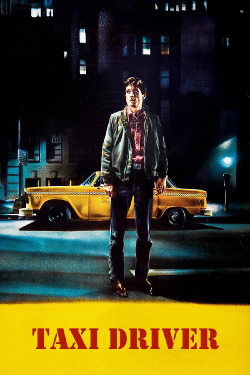
Martin Scorsese's Taxi Driver is an overwhelming reality of violence, and remained as one of the darkest picture about the transformation of an innocent being due to the environment that he's in.
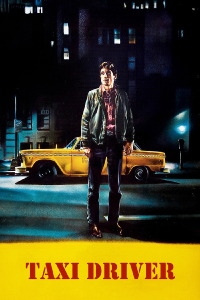
The opening shot shows us a taxi moving through the smokes, like it was emerged from hell. The one that is driving that taxi is Travis Bickle, and inside that taxi, he feels that his passengers act like he's not even there. That is also what he feels outside that taxi, the filthy streets of New York is an even wider extension of his alienated world. It's a nightmare to feel like that, feels like hell.
Travis Bickle is an honorably discharged Marine (Vietnam veteran), he likes to pretend that he's a government employee. He lives alone in his messy apartment, he's an insomniac, constantly takes pills and eats a lot of junk foods and sugar, and the only show he knows to watch in the theater is pornography.
He's a loner too, detached from any meaningful connection from the world, and that's the central theme of the film. But he's making an effort to fit in. At nights, during Travis' working hours, we take a look at the saturated color of New York, the dirty streets filled with all kinds of scum in Travis Bickle's deep paranoid eyes. During the day, we see the hope in living in a place like this.
Travis sets a mission to talk to Betsy, the girl that caught his eyes. This is Travis's way to "become a person like other people." Travis used his charming smile and succeeds. After an awkward conversation during their date, Betsy quoted a song by Kris Kristofferson that she thinks describes Travis, "He's a prophet and a pusher, partly truth, partly fiction. A walking contradiction." Though she has no idea about Travis's life, he's right about the last part. Travis is sickened by prostitutes, but he's got nothing to watch but pornography. He wants to have a healthy body, yet he takes pills and doesn't eat a better meal. Maybe Paul Schrader had given us a glimpse of Travis's personality. Well, to explain his physical appearance, the first two line of that same song is quite exact, "See him wasted on the sidewalk in his jacket and his jeans, wearin' yesterday's misfortunes like a smile." Maybe that's what Betsy was trying to say. Unfortunately, in the end he made a mistake by bringing her in a dirty movie, he says "I don't know a lot about movies." Well, that's sad. And right here, we can see how Travis's charming smile transforms into a sarcastic one.
He was rejected again by the society that he declares like a union, cold and distant. Travis' downward spiral cannot be stop, each time he is going deeper into violence. Travis' confrontation with violence is beginning to be excessive, hearing the words at the backseat by some mad husband planning to kill his wife with a .44 magnum, and in the streets some mad man shouting "I'll kill her, I'll kill her" only deepens Travis' idea of the bloodbath in the brothel later.
He asks for some advice from a fellow cab driver who is older and more experienced, Wizard, but they ended up not understanding each other's point, this is a crucial moment for Travis, he seeks for clarity but did not get it, this is yet another failed attempt to have a connection with another person. He was saying "I've got some real bad ideas in my head." And that idea will come to life, as he buys his own .44 magnum and different kinds of pistols, he gets his first kill on a small store trying to save it from a robber. Travis is also a racist, we can see it in the way he stares at black people, and right after shooting a black robber in the store, he enviously watches a program that shows a happy "colored" couple dancing, maybe in his mind he asks "Why should they be happy when I'm going crazy because of this loneliness?".
Scorsese effectively isolated Travis from the society in each distant shot. Not only that Travis Bickle was influenced by Norman Bates, in Alfred Hitchcock's Psycho, but almost the whole film is Hitchcockian, from Scorsese's cameo, the homage on Rear Window in one scene and the frequent over the head shots. But at some point, Scorsese rises up from his master. In the second part of the film, Travis Bickle became John Wayne, trying to save a young prostitute from her pimp, a mirror plot from The Searchers. After a failed attempt to assassinate a public figure, he went to the brothel where Iris is, the young prostitute he wants to save, played by the 13-year old Jodie Foster. In the bloodbath, violence exploded, released from his captivity, he doesn't know what he is doing, but planned this thing obsessively and now that it had happened, it is ironic that he was praised as a hero who rescues a young prostitute.
The final scene where he drove Betsy into Manhattan, he seems like that he is back into sanity, but again he gave us a paranoid threatening look at the rear-view mirror, like the one he's been giving through the whole course of the film, and you know it might not be a happy ending after all.
Bernard Herrmann's last score was truly a magnificent piece, it colored and shaped the image of Taxi Driver, haunting and unforgettable jazzy score. It will be forever embedded in my heart, whenever I hear it, I always picture a rainy night in the streets of New York, though I haven't been there. Martin Scorsese, Paul Schrader, Robert De Niro all in premium shape and at their best in this agonizing dark masterpiece, and they made a big mark at the 70s, the best decade for films in my opinion. Taxi Driver is so affecting because this story is all too real, Travis Bickle is not just a character in a movie, he is the character of the society, he is the voice-over of the isolated humanity, victimized by the system of the world.
This is Robert De Niro's best performance in Scorsese's best film. They touched my heart and deeply affected me in this film, and I'm eternally grateful for that. Thank you Scorsese and De Niro.
This review of Taxi Driver (1976) was written by Christian C on 31 Jul 2012.
Taxi Driver has generally received very positive reviews.
Was this review helpful?