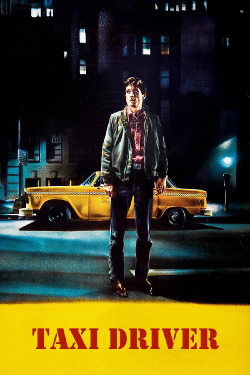
Review of Taxi Driver (1976) by Chris S — 14 May 2014
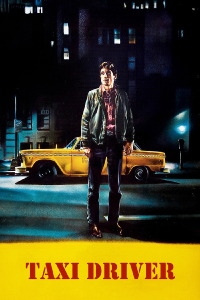
"I have learned more about America from riding in taxi cabs than from all the limos in all the country," declares presidential candidate Sen. Charles Palantine, eschewing sincerity for an ironically condescending tone he uses to convince low-income voters of his populist, every-man platform. In the conversation that follows, Palantine attempts to empathize with Travis Bickle (Robert De Niro), the eponymous anti-hero of Martin Scorsese's 1976 film, Taxi Driver. He asks Bickle what he thinks is the biggest problem with America, to which he responds, "The filth... The president should just flush this whole mess right down the fucking toilet." Palantine, in a falsified gesture befitting of a politician, politely ends the conversation before turning to his associates to laugh about Bickle's nonsensical response. Cut to the next scene, and a twelve-year-old prostitute hops into the very same seat in which Palantine sat, and she screams at Bickle to drive off immediately to help her escape her pimp.
The juxtaposition of these two scenes underscores a political message that frequently recurs throughout the film's two-hour duration: the idealism of politics and mainstream culture versus America's darker actualities, embodied by the streets which Bickle observes nightly through the tint of his taxi's windows. Palantine remains convinced that he understands the state of America and its "normal" people (the wage-earners, the laborers, the cab drivers, etc.), while an entirely darker reality exists under the one he conjures. The American people presented in the film cling to the hopeful rhetoric of false prophets such as Palantine, choosing to believe that the worst issues facing America lie in poor foreign policy and unfair income distribution. They turn a blind eye to the individuals deeply affected by systematic flaws, thus choosing to ignore the disturbed nature of men such as Travis Bickle. The negative effects of the public's forcible disillusionment are compounded by their fetishizing of violence, shown by the ultimate tabloid glorification of Travis's massacre. These dangerous misconceptions about the American Dream and about what is important in society result in Travis's circular character arc.
The audience's perception of Palantine proves itself largely underdeveloped, as Scorsese never gives us an overt opinion on him. As the narrator and the viewers' only real frame of reference, Travis Bickle proves useless in forming a stance on Palantine. Travis repeatedly says, "Well, you know I don't follow political issues that closely," leaving the audience to assume that he formed his initially supportive view of Palantine merely to get closer to the woman of his dreams, Betsy (Cybill Shepherd). That being said, Palantine clearly works hard to maintain the façade of the average Joe's politician, a unifying figure who can re-instill hope in the American Dream and service people of all ethnic and socioeconomic backgrounds (not unlike Bobby Kennedy). His main conceit, of course, is that he himself leads a privileged life and cannot possibly count himself among those included in his campaign slogan, "We Are the People." Even the volunteers working in his office clearly come from privileged backgrounds, judging by their appearances and by the fact that they can afford to work full-time without pay. And yet, Charles Palantine claims to be a part of the people's "struggle," and ensures widespread reform across issues involving the military, poverty and race relations.
Scorsese and writer Paul Schrader never let us forget how absurd it is that this amount of idealism exists within a film narrated by a neurotic war veteran who likely suffers from PTSD. This contradiction never really lets the audience find ay truth in Palantine's inspiring rhetoric. For example, a tracking shot through the audience at the Columbus Circle rally focuses on the torsos of individual supporters, finally settling on the instantly recognizable Army surplus jacket of one Travis Bickle. From this angle, he looks like just another body in the crowd, until he pops open his pill bottle and knocks another couple back as the camera tilts upward to show his face, an act that immediately sets him apart from the crowd, but is further emphasized by his radically altered appearance. De Niro sports a devilish grin and a Mohican-style Mohawk, a hairstyle change that he and Scorsese decided upon after learning that the Special Forces in Vietnam adopted it for dangerous missions. His freakish appearance and casual pill-popping distinguish Bickle as one who does not fit within Palantine's vision of the American people. Scorsese could have opted to portray Travis as just another face in the crowd, but instead he chooses to visually set him apart from the rest. It is a stark juxtaposition between the candidate's self-assured speech and the would-be assassin's psychotic mannerisms, but one that Scorsese repeatedly emphasizes to show the disconnect between mainstream America's political idealism and the uglier realities of life.
The public's self-imposed ignorance to the existence of men such as Bickle proves dangerous on its own, but it immediately becomes a ticking time bomb when coupled with their fetishizing of violence. The Americans presented in the film believe in the heroism of John Wayne and of other lone wolf gunslingers (as evidenced by the hero worship Bickle receives after the massacre), yet they have no conception of how this reverence impacts a man like Travis. Taxi Driver's sultry, jazzy score at times echoes the backing music of the porn films Travis sits through, and at times invokes horror film-esque insanity, but it also obscures the Western narrative intrinsic to Bickle's character arc. Travis is undoubtedly a loner, a man incapable of human connection and one perceived as a complete freak by "normal" people. While he establishes some sort of relationship with Iris (Jodie Foster), he completely sabotages his chances with Betsy by taking her to a dirty movie on their first date. I would argue that Travis's subconscious drives Betsy away on purpose, because he wants to believe in his vision of the world, that he alone stands above the mess (In an interview, Scorsese said Travis envisions himself as an "avenging angel."). "I see now that she is just like the others," he narrates.
His failure with Betsy-intentional or otherwise¬-allows Travis to condemn the world in its entirety and assign himself the deadly purpose of killing off the "scum" in one final, Western shootout-style scene. The film's tagline reads, "On every street in every city, there's a nobody who dreams of being a somebody." The concept of the American Dream and the public's negative perception of outsiders force Travis to find his own means of becoming "somebody," and he does so by capitalizing on the public's violent fetishes. First, though, he convinces himself that he must transform himself into the killing machine that will most captivate the public's eye. He begins this process by purchasing guns.
"You should see what a .44 Magnum can do to a woman's pussy," declares a deranged taxi passenger (portrayed by Martin Scorsese himself) early on in the film. From that point on, Bickle comes to associate the weapon with the masculine hero he intends to embody. When he meets with the sleazy gun salesman, he immediately asks, "You have a .44 Magnum?". At this point in time, the gun itself had already made its way into pop culture and taken its position as the weapon of choice for the Western hero. In the original Dirty Harry film, Clint Eastwood (a man whose masculinity has, on multiple occasions, been the subject of academic literature) calls the .44 Magnum, "The most powerful gun in the world, and it will blow your head clean off." Again, it is no accident that Travis chooses this particular gun out of all the possibilities. To him, the .44 Magnum is a vital ingredient in his recipe for creating a violent persona that will make him somebody by captivating the public's deranged sense of heroics. On a visual level, this obsession with the gun presents itself almost immediately following the interaction with the gun salesman, as the audience finds themselves alone with Travis in his run-down apartment. With his newly muscled body on full display, De Niro stands facing the mirror, which happens also to be where the camera rests. He repeatedly draws and pretends to fire the .44 out of an ancient leather holster right out of a Sergio Leone film. Add in the Bowie knife he eventually uses to stab the timekeeper's hand, and not a single person could doubt Bickle's intense, heroic masculinity. Imagery of the .44 Magnum also pops up in the tracking shot of the massacre's aftermath (one rests at Travis' feet, and a bloodied one lies in Sport's hand), further likening the scene to a Western shootout via visual contextualization.
An alternate reading of the film explains Travis' need for violent behavior as his form of release, something he finds himself unable to attain through sexual means. At one point, the Wizard (Peter Boyle) suggests Travis let out some of his anxiety by "getting laid or getting drunk," a suggestion that Travis barely seems to register. Soon after the audience meets Travis, we find him in a porn theatre, half-heartedly hitting on the lady working the concessions stand and then disinterestedly viewing the action onscreen, as the voiceover narration rambles on about his insomnia. Travis only seems to find arousal in the porn theatre once he has purchased his guns, when Scorsese interjects a shot of De Niro pretending to shoot at the actors onscreen. This theory of Travis finding some sort of orgasmic release through violence provides an interesting insight into the narrative of the film. It leaves open the possibility that, if he could let off anxiety through sexual means, perhaps he would have ended up just "making it" with Iris instead of feeling the need to violently save the damsel in distress by killing her captors.
However, the possibility remains that the idea of Travis utilizing violence to capture the public's attention and make himself "somebody" can work hand-in-hand with the theory of him using it for release. If Travis ultimately wanted to find identity or meaning through attention and notoriety, then he achieved his goal. The public, as one could have expected, glorified Travis's actions. The tabloid headlines on his apartment wall read, "Taxi Driver Battles Gangsters" and "Taxi Driver Hero to Recover," instead of "Psychotic Loner Murders Three People." However, if he wanted release, then that means his character arc is caught in a cycle (repression, anxiety, then release) implying that he will have a violent outburst again. Paul Schrader once said that he thinks if you attached the end of the film to its beginning, it would still make sense in terms of character arc. "Travis is not going to be a hero next time," Schrader said. Visually, this is supported by the film's first and last shots of Travis Bickle. In each of them, the audience sees only his eyes as framed by the rearview mirror of his taxi, a slight red hue imbuing the image with a sense of doom.
Whether Travis wants release or glorification almost does not matter, as it does not change the film's underlying political messages. The public forcibly disillusions itself into believing the false of idealism of insincere politicians, effectively ignoring both the darker realities of street life and the twisted minds of social outcasts. This blindness coupled with the American people's obsession with violent, masculine heroics creates a pressure cooker in the minds of men like Travis Bickle, and on a broader level reflects the inequities inherent in American society.
This review of Taxi Driver (1976) was written by Chris S on 14 May 2014.
Taxi Driver has generally received very positive reviews.
Was this review helpful?