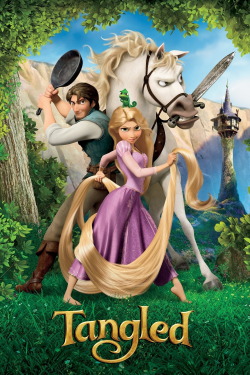
Review of Tangled (2010) by Shiira — 29 Nov 2010
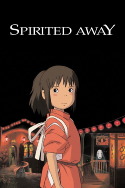
It's not so simple to say that the whole entire kingdom is turning Japanese during the Hayao Miyazaki-influenced floating lantern ceremony. Modeled after "anime", what the Japanese refer to as traditional animation, the released lanterns which ascend towards the sky by the king's decree, function like the lanterns in the Toro Nagishi ritual, a Japanese observance based on the concept that the illuminating light will pilot the roaming spirits of the departed back to the other side.
Knowing about this Buddhist tradition gives the royal parents an extra layer of pathos, because the annual ceremony, given the context of the film, seems to be predicated on the belief that the princess is alive and well, somewhere in the woods.
The significance of the portable lighting devices will be lost on a western audience, but those who know their Asian lanterns will know that down deep inside, the king and queen believe in their heart of hearts what they perceive to be the truth about Rapunzel, the little girl who was snatched out of her crib so many years ago: she's gone, thus the lightweight lamps are offered to her memory as a guide towards some peaceable kingdom in the heavens.
Those lanterns, however, are placed in the water. The flying lanterns are actually Chinese lanterns, Kongming lanterns, which are used in celebrations(primarily in a Thai festival called Yi Peng), and symbolize the universal human desire that all your problems and worries could simply float away, light as air.
The two lantern traditions are tangled, but you never see the Chinese side of things, since the filmic signifier, the old-fashioned Miyazaki 2D-style that the Disney animators translated into the cartoon language of CGI, is Japanese.
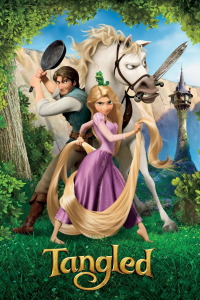
Therefore, the diegesis can be misleading, especially for those who don't know one lantern tradition from another, just like the trailer that preceded "Tangled", where the emphasis on Flynn Rider(Zachary Levi) absurdly upstages Rapunzel(Mandy Moore), as if girls matter less than boys, a notion that coincides with the Chinese/Japanese binary, in which the tradition of the former believes this to be true.
Marketers know best, and marketers know that a film where the primary relationship is between a daughter and her "mother", and even worse, belt out showtunes, collectively, about independence and the anxiety over facing an empty nest, may scare off teenaged boys(the demographic that matters most in the biz), who wouldn't be caught dead at such a female-centric musical, otherwise.
Gothel, Rapunzel's keeper, is not a one-dimensional villain like past Disney anatagonists; she manipulates Rapunzel with scare tactics and emotional blackmail to discourage her charge from wanting to venture out into the world, but the film hints at the possibility that the wizened old woman(made eternally young through the magical properties of the lost princess' long locks) loves her prisoner, completely independent of her parasitic need for Rapunzel's enchanted hair.
In a sense, Gothel is just like any co-dependent mother, especially mothers who hail from non-western cultures where children are expected to provide care for their infirm parents as adults. Old people can suck the life right out of you: a cold, hard truth exemplified earlier this year in Nicole Holofcener's "Please Give"(the Rebecca Hall character spends a lot of time in a tiny apartment holed up with her grandmother), and in "Tangled", we see the metaphor, as Gothel siphons out a little more of Rapunzel's essence each time she renews herself through Rapunzel's hair.
Anybody who has ever been a caregiver will relate to the warring emotions, an intermittence of giddiness and guilt, that the girl undergoes when she gets her first taste of freedom after Flynn rescues her.
After all, Gothel is the only "mother" she knows. Akin to a Japanese lantern, Flynn casts a monolithic presence over the proceedings in his own right, as both Rapunzel and the Chinese lantern are supplanted by the perceived stronger sex, and heritage(current status of the rival countries, notwithstanding), who co-opted their neighbor's culture and made it their own.
This review of Tangled (2010) was written by Shiira on 29 Nov 2010.
Tangled has generally received very positive reviews.
Was this review helpful?