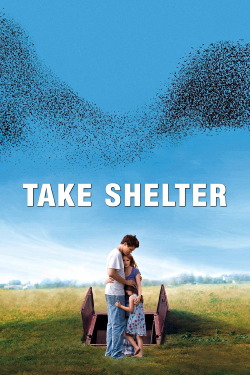
Review of Take Shelter (2011) by Sean D — 25 Jul 2012
The Romantic (i.e. Wordsworth, Byron, Shelley, etc.) notion of the sublime relates to a quality of greatness, usually in nature, that cannot be measured or calculated to the point that it borders the horrific. If there is a film that comes close to capturing this notion on screen, it is Jeff Nichols's "Take Shelter.".
Michael Shannon's Curtis is a blue-collar worker of the American midwest who, with his wife Samantha (Jessica Chastain), look after their deaf daughter Hannah. As Curtis works to ensure that Hannah's cochlear implants are covered with his insurance, his mind begins to slide as his family history of mental illness begins affect him. He becomes haunted by nightmares and visions of impending apocalypse, which provoke him to irrationally build a storm shelter in his backyard. As his mental health deteriorates, it begins to affect those around him, including his work, his family, and his good friend Dewart (Shea Whigam).
Curtis's mental anguish becomes the audience's as Shannon's brilliant performance throws the viewer into his world where reality and fiction are blurred. The terror of the impending storm, and the brutality of humanity that follows, are portrayed in stark, yet hazy, terms that, despite their opacity, seem as clear as day to both Curtis and the audience. By making the visions seem real, Nichols causes the viewer to doubt these hallucinations while also maintain the nagging feeling that this might be true. The visions as prophecy is stressed with brillant terror in Curtis's fire-and-brimstone style breakdown in front of the onlookers at a community gathering.
More devastating than Curtis's mental issues is his pride, which is just as detrimental to his family as his schizophrenia. His blue-collar sensabilities tell him to mask his problems and refuse any proper help. He goes to a counsellor, rather than a psychiatrist, in an attempt to deal with his mental illness. He goes to the bank and acquires another loan, which he says is for home improvements, in order to pander his irrational desire to build the shelter. He hides his illness and intentions from his family. When Samantha discovers what he is doing, the chasm between them widens and their relationship suffers.
The torrent between Samantha and Curtis matches the imagery Nichols invokes regarding Curtis's vision of the apocalypse. Oil falls from the sky. Large, violent storm clouds gather over the flat Midwestern landscape. Roving gangs of masked fiend threaten his daughter and his life. The rich cinematography reveals the extent to which Curtis fears what he thinks is coming with terrifyingly beautiful shots of the Ohio landscape set against ominous, coal-coloured clouds. These images are as resonant the performances themselves.
When I think of great films, I think of films that stay with me well after viewing it. The coolness incarnate in 'Pulp Fiction.' Dennis Hopper's mania in "Blue Velvet." The absurdity of the Cold War in "Dr. Strangelove." The rage of "Network." The sweeping beauty of the American Southwest in "Paris, Texas." The sheer sublimity and mental horror conveyed in this film will haunt you like no other.
This review of Take Shelter (2011) was written by Sean D on 25 Jul 2012.
Take Shelter has generally received very positive reviews.
Was this review helpful?