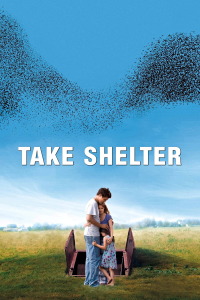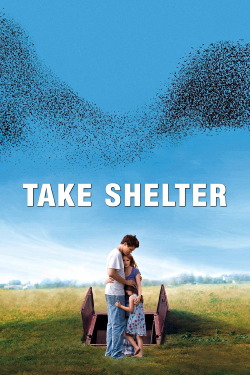
Review of Take Shelter (2011) by Edgar C — 31 Dec 2013
In my opinion, the most correct approach is to see the story as an allegory. About what? About what your heart tells you, not about what your mind tells you.
"We think too much and feel too little.".
- Charles Chaplin.
On one hand, you have the set of societal rules and "rational" set of steps you need to take in order for you to have a mental state that the rest of the society will therefore catalogue as "stable" and "normal". On the other hand, you've got the indestructible power of family support and inspiration: the only source of comprehension and support comes from the wife (whose personality, love and loyalty reminds me of my girl: that's exactly what she would do if I were in Curtis' place); the only source of inspiration comes from both the wife and the daughter. There is not a stronger motor than the ones closest to you to keep living.
We also find, on the same side of the story, our personal storms and how we choose to face them. Either we build a shelter and deny reality, or we pay attention to those close to us. Everyday, every action and step we take have a direct or indirect, weak or strong impact on others, like a butterfly effect. The lives of others would not be the same without our existence. This axiomatic principle does not apply only to friends and family, but to everybody.
Now, we have to make a choice: either to be concerned about the uncertain future, or to worry about today. I think that the most important state of our existence is the present, because it is the present that drives the future, not the past. The present is that indivisible atom of time that prolongs the past and kisses the future. It is the only fragment of time that we are aware of us, that we are. We just are. We are today. We think we will also "be" tomorrow, or in a second, but the fact is that we are not sure.
So, why the storm at the ending? Because the storm had to happen that day. It didn't happen before. The time to be concerned about the final storm is that final day. There was no need to be concerned weeks beforehand, becase the shelter, the money spent, the lost health insurance, the lost job, everything was for nothing. It brought along evils. Still, in the context of the film, those were necessary evils, because it brought along something of (hopefully) permanent value: Curtis realized that his family trusts him, that his daughter is concerned about him, and that his wife would never lie to him. With this, he could "open the shelter" and "see the light": everything was fine. He is fine with his family. He is fine with himself.
I hear interesting comparisons of the film against A Serious Man (2009), which is like comparing a duck with a lion: they've got nothing to do with each other. The vibe provided is the same, but the message is not.
So the message is: you will have troubles, and you will suffer in the future. But today, you are fine. Or maybe today, you are facing that trouble. The present is the only time that is alive and "is". Why should you worry about that which has not happened, and probably won't happen?
A new talent has emerged, and his name is Jeff Nichols, who has enough ability to transmit several feelings with extraordinary precision: from authentic marital love, to hopelessness, to tension, to shivers, to sadness, to empathy, all compiled in a complete two-hour celluloid package with a powerful cinematography that captures its beautiful and ghastly imagery like a painting.
Allow me to quote the Bible to make my final personal statement:
To every thing there is a season, and a time to every purpose under the heaven:
A time to be born, and a time to die; a time to plant, and a time to pluck up that which is planted;.
A time to kill, and a time to heal; a time to break down, and a time to build up;.
A time to weep, and a time to laugh; a time to mourn, and a time to dance;.
A time to cast away stones, and a time to gather stones together; a time to embrace, and a time to refrain from embracing;.
A time to get, and a time to lose; a time to keep, and a time to cast away;.
A time to rend, and a time to sew; a time to keep silence, and a time to speak;.
A time to love, and a time to hate; a time of war, and a time of peace.
Ecclesiastes 3: 1-8.
97/100.
This review of Take Shelter (2011) was written by Edgar C on 31 Dec 2013.
Take Shelter has generally received very positive reviews.
Was this review helpful?