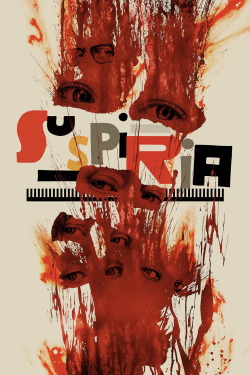
Review of Suspiria (2018) by Bertaut1 — 02 Dec 2018
Politically juvenile, with a troubling approach to the Feminine, but it's certainly convinced of its own profundity.
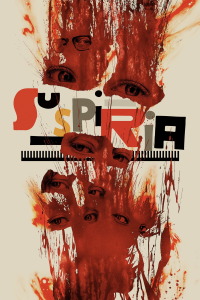
A remake of Dario Argento's 1977 giallo classic, Luca Guadagnino's Suspiria has an intricate plot covering all manner of themes and topics, and featuring several new characters. Seeing itself as a psychoanalytical investigation of national trauma and World War II guilt, an exploration of female sexuality, a celebration of a self-contained matriarchy set against the destructive chaos of a failing patriarchy, its rather an overlong, dull, self-important, incoherent mess.
Set in "Divided Berlin", the film follows Susie Bannion (Dakota Johnson), a Mennonite from Ohio who is admitted to the prestigious Helena Markos Dance Academy by lead choreographer Madame Blanc (Tilda Swinton). Meanwhile, whilst also investigating the Academy, Dr. Josef Klemperer (Tilda Swinton, credited as Lutz Ebersdorf), is trying to find what happened to his wife, Anke (Jessica Harper), who disappeared in 1944. At the academy, the coven of witches who run it are holding a fractious election for leader.
Set in October 1977, against the backdrop of the German Autumn, it's in relation to politics where we encounter the first problem. Guadagnino, working with screenwriter David Kajganich, employs a pseudo-Jungian approach to show that the country's political turmoil runs parallel to the struggle for control of the coven. The once harmonious group has now devolved, just like Germany, into factionalism, political manoeuvring, subterfuge, and animosity. But to what end does he make this parallel? What is he trying to say? None of the political symbols inform any grand thematic statement.
Another problem is Klemperer, who's not in Argento's original. In a story ostensibly about the Feminine, it's rather troubling that the emotional core is male. The film's preferred point of view is his, with even the epilogue focusing on him. He is quite literally a man in a woman's world.
Which brings us to another theme; femininity. As Klemperer is played by Swinton, the film effectively has an all-female cast, however, it isn't interested in idealising female empowerment. Instead, it depicts a matriarchy beset by disruption and the chaos of a struggle for power. However, there's a very thin line between condemning the male gaze and recreating it, and it's a line which Suspiria frequently crosses. Maybe the problem here is simply that a story about matriarchy, female empowerment, and motherhood, is a story a man can't tell very well. I'm reminded of Sofia Coppola's remake of The Beguiled (2017), of which she argued, "this story had to be directed by a woman. The essence of it is feminine, it's seen from a female point of view." Suspiria also has a feminine essence, but it doesn't have a female point of view, and one can't help but wonder what a talented female director like Coppola, Mary Harron, or the genius that is Lynne Ramsay would have made of this material.
However, even aside from these problems, there are a plethora of other issues. The character of Blanc is poorly written, and is stripped of agency towards the end of the film. As for the matrons, apart from Tanner, none receive an iota of characterisation. The same is true of the dancers. The film is also immensely silly in places. For example, the climax is presided over by what can only be described as a female Jabba the Hut wearing sunglasses.
On the plus side, there's a great deal to admire aesthetically. Walter Fasano's editing is disjointed and cinematographer Sayombhu Mukdeeprom's compositions often give a less than perfect view of a particular space. Combined, these two techniques are disorientating and frequently defamiliarising. Especially noticeable is the film's colour, or lack thereof. Whereas Argento's original was awash in garish and exaggerated reds, purples, blues, greens, and yellows, Guadagnino's remake was conceived as "winterish", with as limited a use of primary colours as possible; grey, beige, and brown predominate.
Self-indulgent like little else I can think of, Suspiria is absolutely convinced of its own profundity. Far, far too long and far too self-serious, its themes and messages are poorly iterated. The slight story at the film's core (a coven of witches using a dance academy as a front hold an election) is unable to bear the massive weight of themes heaped upon it; the vehicle just can't carry the message. Its politics are no more insightful than tabloid headlines, and serve only to detract from what is supposed to be the narrative's focus. Ultimately, it has little to say about femininity, feminism, political protest, the Holocaust, Cold War Germany, or World War II guilt, but it sure works hard to convince us it has a great deal to say.
This review of Suspiria (2018) was written by Bertaut1 on 02 Dec 2018.
Suspiria has generally received positive reviews.
Was this review helpful?