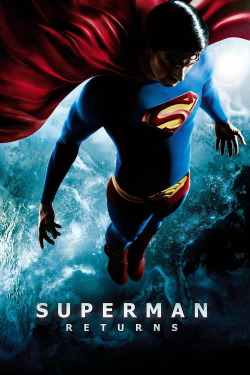
Review of Superman Returns (2006) by Mariel33 — 14 Aug 2017
Overall, Superman Returns is the sort of force that's irrational, yet is ironically able to gain value by being aware of itself. What's meant by this is that the irrationality in question is perhaps that it's acceptable to oppose self-awareness without reason, and that the source of this dynamic isn't meant to be understood.
Possessing self-awareness is a type of division, ergo a type of conflict. So from this definition, what can be projected onto Superman Returns is the formula that the source of being self-aware is the irrational, but, because that source was always inevitable that means that it's okay for an outcome of purity to derive from the act of self-awareness. Of course, the next problem that leads from this is that if Superman Returns is a process of getting to purity, is that meant to suggest that the movie itself is an evil product?
Even if Superman Returns isn't evil per se, on the basis that evil is true, that still leaves the worrying and disturbing idea that Superman Returns is partly evil incarnate. Which makes sense, given that the story does feel very eerie, and very poignant and about impending doom. But then again, if the story is about impending doom, that provokes the great idea in which Superman Returns can be understood as a perfect encapsulation of a trade of identities: the story is about impending doom, and therefore the external product possessing the story being the process to purity is a very neat and very impressive reality. The probability, is that Superman Returns is indeed what's just been described. It doesn't seem far-fetched or out of place to perceive Superman Returns this way, but, there is then a new issue that arises: if this identity of purity for evil is real, is it worthwhile to point out that it's possible that this nature is a justification for the movie? If the justification is real, perhaps it's just a consequence of the story that the complexity isn't able to deal with the justification. After all, the purity that's ostensibly linked to the product isn't an actual part of the experience, not even when Kal-El visits Jason at the movie's very end, and so it seems fair game to think of Superman Returns as a type of failure. Failure, in this sense, isn't negligible but it also isn't important. The fact is that Superman Returns is a tremendous emotional experience, and frankly represents a much better type of art and philosophy of film-making than most other superhero and fantasy movies do. In the world of Superman Returns, the mundane and the common are the special and the supernatural. The typical human experience is the value of the story, the clear pattern of the story being the link between complexity and uniformity.
In Superman Returns, spectacle derives from uniformity, but link between spectacle and uniformity is the theme of the movie rather than just some accidental byproduct. The supernatural nature of uniformity being possible is the movie's spiritual essence, and this is the sort of story depth that far outshines many other sci-fi classics. It's a crime that Superman Returns never got a sequel, but at the same time it isn't any wonder from an artistic perspective, similar to Batman & Robin.
At the end of Batman & Robin, Barbara Wilson joins Bruce Wayne and Dick Grayson to become a trio of superheroes; because of this intellectual development, it isn't a surprise that Batman & Robin never got a sequel, because the conceptual specialness of Batman, Robin and Batgirl was too precious to actually manifest. Superman Return was the exact same reality, ending on such a conceptually exciting and emotionally uplifting note that the prospect of any sequel to Superman Returns would've been daunting to say the least.
This review of Superman Returns (2006) was written by Mariel33 on 14 Aug 2017.
Superman Returns has generally received positive reviews.
Was this review helpful?