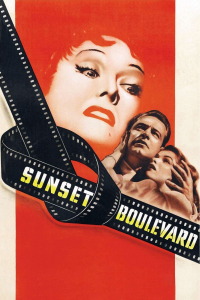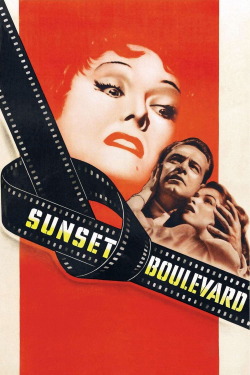
Review of Sunset Boulevard (1950) by Kylie P — 13 Feb 2010
From June 30, 2008:
Sunset Boulevard has a lot of layers. On the one hand, it is a biting, merciless swipe at the Hollywood machine, made even more effective by the fact that there are cameos from several old-time Hollywood biggies, not the least of which includes the man himself, Mr. Cecil B. DeMille. Casting an actual silent film actress was a stroke of genius (her old films could be mined for versions of Swanson's younger self). On the other hand, it's a murder mystery with noir narration, playing up some Hollywood conventions of the period to over-the-top effect. On still another hand, the noir aspect comes off a bit tongue-in-cheek, with some hammy and cheesy lines from Holden's Gillis that leave the viewer perplexed as to whether they should laugh or cringe. Apparently, Wilder wrote it originally as a comedy, and it retains some comedic flavor, even thought the events of the story are anything but funny.
There are some narrative and direction flaws. Norma, as a character, is incomplete - or contains too many superfluous bits of randomness. Gloria Swanson played her with great gusto (she practically embodies the phrase "over the top"), and that paints the picture of crazy quite nicely, but random factoids pop in and out of her story that seem to have no place in the overall arc of her character, whereas other bits of the story seem to have obvious holes. Some of it is simply to drive home her eccentricities, such as the introductory (but random) death of her beloved monkey, which is also a funny, satricial bit to set the mood not only of eccentricity but of excess. Some of it simply results in leftover wondering: she had three husbands? Where did they all go (no spoilers here, folks)? Also, she was always a bit dotty, but why did she break with reality during the concluding moments, during this particular event? Other than her zeal for fame and maybe some guilty feelings on her part for various behaviors, why then? It seems that too much was left out of the picture, even if the picture's focus was meant to include Joe too.
Joe was also an imperfect character, but at least his imperfections were consistent. He was not very bright; none of his decisions were good until his final decision, but at least his character story had motivation: the high life of Hollywood versus the alternative of a $35/week desk job in Ohio, and at least, he strived for last minute redemption. Norma had motivation too, mostly, arising from loneliness and hunger for the adorations she used to enjoy, but there seemed to be too many loose ends. If the viewer is meant to be kept guessing, the movie works, but is that this film's intention, since the film opens with the "it" of the whodunit?
There was also some erratic pacing. The film, already a slow and methodical flashback account of a murder mystery, slows up considerably during the parts in which Joe is especially enjoying the perks of escorting the aging starlet about town. While his narrative voice waxes about the "prison" he's found himself in, the movie shows him shadowing Norma to bridge games and attending not-so-well-attended soirees. It's no doubt meant to give the viewer a sense of irony, as well as give Joe the opportunity to encounter Betty randomly a few times, but it brings the movie to a slow crawl.
The photography and lighting were superb, rendering Norma's decrepit mansion almost like a haunted house, occupied by the ghosts of her lost career. A great shot was when Norma and Joe are watching one of her old silent films, and she gets into one of her impassioned fits about making her return, and she stands up, her face pointed toward the flickering light of the movie projector, a ghostly reminder, perhaps, of the star she used to be. The art direction was also wonderful: consider all of the props and trinkets lining Norma's mansion, an extension of her somewhat-mad self. The most effective prop was her eccentric little cigarette holder, the best material representation of her madness in the entire film.
The performances were also good. William Holden is pretty much always good, and Gloria Swanson was just so over-the-top, so theatrical...as was the score, which was as melodramatic as Norma Desmond herself.
Still, the film felt really dated and not in that charmingly nostalgiac way. It gets points for taking on Hollywood when the system held so much sway (reportedly, studio heads were not happy with it). And even though "I'm ready for my close-up" is the most famous quote of the film, the other famous quote-- "I am big. It's the pictures that got small"-- is so much more representative of Sunset Boulevard and the main character; alas, it's not as well-known and didn't come with Gloria Swanson's huge, insane eyes and slow approach toward the camera, but it's got the essence of the satirical subtext of the film.
This review of Sunset Boulevard (1950) was written by Kylie P on 13 Feb 2010.
Sunset Boulevard has generally received very positive reviews.
Was this review helpful?