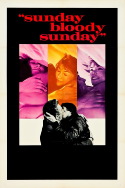
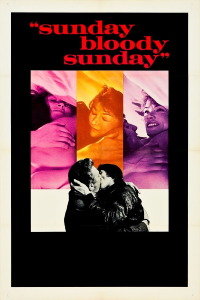
Review of Sunday Bloody Sunday (1971) by Ripö M — 28 Jul 2010
John Schlesinger's Sunday Bloody Sunday is social realism, as seemingly unusual as its scenario is and however much poetic license the script and direction take. Yes, it defies all perceived social convention. We follow a triangular sexual relationship comprised of a man and a woman, both middle-aged, and another man, much much younger. There is a scene where young children innocently smoke a joint after breakfast, because they know where their out-of-town parents keep it. But the lack of permanence implicitly shown in mercilessly intimate scenes of parties, workplace conflicts, doctors' appointments, bar mitzvahs, et al, are concerned with the politics of the personal rather than the traditional. It's an exploration of characters at crossroads in their lives, those roads intertwined.
The screenplay by Penelope Gilliatt takes us through eight or nine days, while a young man, played very becomingly by British singer Murray Head, plans to leave for New York. Both of his lovers will miss him, and I guess he will miss them, in his own way, yet he has chosen to go, and between them, they don't entice him enough to make him want to stay. So the two love affairs begin their dissolution, while the lovers go about a moody everyday life in a London mostly comprised of frigid twilights. An aria from Mozart's comic opera Cosi fan Tutte is played on the soundtrack with ironic detachment. And then there is Mendelssohn's utterly romantic On Wings of Song, its minor key tonality embraced.
Both the doctor and the woman are concerned with helping people, he by an altruistic and astute way with his patients, she through working in an employment agency. The boy however gives the impression of being solely absorbed in the marketing possibilities in America for his ultra-modern sculpture. He isn't even worried whether his stuff is any good, but whether it will sell to Americans. Indeed, he doesn't appear to feel very intensely about anything. He is nice enough and open enough, but there is no range to him, as there is to his lovers.
Played with perfect pitch in deservedly Oscar-nominated performances by both the great Peter Finch and Glenda Jackson, it is with these two older characters that we get to the nerve center of the story. They survive in a lose-lose world by adjusting themselves to life as it must be lived, such as how Finch, the doctor, not at all internally bothered by his homosexuality, doesn't disclose it to his opaque Jewish family. Continuing fraternization as usual with them is another way for him to survive. Jackson says late in the film, "Some people believe something is better than nothing, but I'm beginning to believe that nothing can be better than something." Well, possibly so, but we get to know her well enough to reckon that she will shake on something, not nothing, once more the next time.
That they're inclined to share him is maybe a tell: They share him not because they're inclined to accept half, but because they're apprehensive about going for all. The three-sided understanding is somewhat an assurance that no one will get in so far that being refined won't be barrier enough against heartbreak. It's the ultimate moral dichotomy in liberalized society: The philosophy of whatever works, but that can hurt people. Yet don't people suffer when bound by convention too? We are free to do what we want, but then people still choose to do what they don't want to do at all.
Look at the scene where the young man and his female lover, who is watching her friends' children, and they have a fun time in a park by a church, which unexpectedly and senselessly leads to a tragic accident involving their dog: The kids are all having happy reckless fun, but there are casualties. The little girl disobeys, but she's a little girl in the throes of fun. Her dog's accident is nevertheless her fault. With pleasure, blameless or not, there is always pain, intended or not.
This review of Sunday Bloody Sunday (1971) was written by Ripö M on 28 Jul 2010.
Sunday Bloody Sunday has generally received positive reviews.
Was this review helpful?