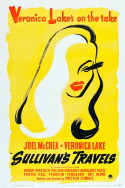
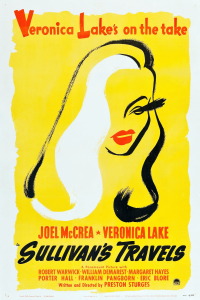
Review of Sullivan's Travels (1941) by Nick R — 13 Dec 2008
As one of American cinema's earliest auteurs and cutting a distinctly modern figure (his mother's best friend was Isadora Duncan; he spent his youth criss-crossing the Atlantic; a "kiss-proof" lipstick and ticker-tape machine were among his patented inventions), Preston Sturges was responsible for an explosion of now-classic films in the 1940's. These films are known for their sophisticated verbal wit, uproarious physical comedy, and their affectionate portrayal of eccentric, scene-stealing supporting characters. But Sturges's work is also consistent in its exploration of the possibilities and prospects of upward - and occasionally downward - mobility. In what may be his finest, most complex film, Sullivan's Travels(1942), Sturges brilliantly mixes broad humor with sharp-edged cultural commentary, once again - as in The Great McGinty(1940), Christmas in July(1940), and The Lady Eve(1941) - revealing social identity to be a highly unstable proposition, capable of hyperbolic transformation through such prosaic means as disguise, confusion, and self-deception.
John L. Sullivan (Joel McCrea) is a can't-miss Hollywood director who specializes in lightweight entertainment, exemplified by broad comedies such as the 1939 film Ants in Your Pants. Naive and sheltered by a solicitous staff who have no interest in seeing their meal ticket change genres or become overly ambitious in his cinematic pursuits, Sully nonetheless sets his sights on directing an epic social commentary picture about tough times in depression-era America, to be entitled O Brother, Where Art Thou? (a fictional title eventually used by the Coen Brothers for their own 2000 film, in a clever tribute to Sturges). To research his topic, which involves such unpleasantries as suffering, deprivation, and racial inequality Sully insists on disguising himself as a hobo and making his way across the country to experience "real life" firsthand.
Once on the road, assorted adventures, meetings (notably with Veronica Lake's down-on-her-luck ingenue), and mishaps - some hilarious, others surprisingly poignant - transpire before Sully eventually comes to terms with his true calling as a lowbrow moviemaker with a gift for making people laugh. The lesson here is that strained seriousness and forced profundity have far less benefit for the masses than good old-fashioned humor, with its power to help people forget their troubles, if only for a while.
That Sullivan's Travels possesses an autobiographical dimension is impossible to deny, with Sturges affirming the value of what he himself did best - making smart comedies with the power to lift viewers' spirits - while ripping the pretentiousness of Hollywood's more sober and "socially committed" filmmakers. Personal statements aside, however, the tour de force script brings together a remarkable range of genres, including slapstick, action, melodrama, social documentary, romance, musical, and prison movie. Though it failed to garner a single Oscar nomination, Sullivan's Travels is the most remarkable film in the career of one America's greatest filmmakers.
This review of Sullivan's Travels (1941) was written by Nick R on 13 Dec 2008.
Sullivan's Travels has generally received very positive reviews.
Was this review helpful?