Review of Sugar (2008) by Nathan F — 21 Apr 2009
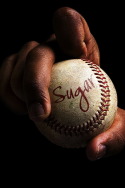
Sugar is a 'baseball' movie directed by indie-famous couple Ryan Fleck and Anna Boden (of Half Nelson fame) about the on and off-field life of Dominican pitching prospect Miguel "Sugar" Santos. Flagged as 'neorealist,' the picture luckily doesn't take after the shallow flaccidity of Kelly Reichardt's Wendy and Lucy (abysmal) or the inconsequence of Ramin Bahrani's Chop Shop (alright); Boden and Fleck have rehearsed the mechanics and there's plenty to admire in their newest effort.
That the film opens at a 'baseball academy' should give newcomers and the sporting-illiterate an idea of how seriously the Dominican Republic takes baseball--the esteem and pride following those that make it stateside can be easily likened to that of our own enduring championing of national service (which makes, later, a passing remark to Iraq seem more of an appropriate approximation than a covert political jab) --and Santos is one of several vying for a plane ticket. Softspoken and hispanic-handsome, Santos clearly embodies the immigrant experience (at a Q&A following the film, Ryan said he wanted to make a baseball movie, Anna said she wanted to make a coming-to-America movie. Sugar is their compromise) and if you're one of those types who isn't automatically sympathetic to a 90-mph fastball, Fleck and Boden cast the Christ-figure brushstrokes broad--when not on the field, Santos is a carpenter.
It's been a flaw of baseball movies in the past (do any great ones exist?) to focus mostly on the game itself, when the field is a conveniently perfect metaphor for the outside world--taking decades as innings, it wouldn't be hard to transpose a lifetime to a ballgame scorecard. More than its counterparts, baseball calls for a greater number of characters, each as important as the next, all in order to support the team. Games cannot be carried by a single all-star--even the best pitchers are part of a 5-man rotation, and even if they pitch well their efforts could be annulled in the very next at bat with no opportunity for a second chance. There are twice as many games in the MLB than the NBA and tenfold those in the NFL; there are rarely breaks of longer than a few days. There are not 'bad games,' but 'slumps,' where a player almost inevitably plays poorly not for a game or two, but for several weeks. As Ted Williams said, "Baseball is the only field of endeavor where a man can succeed three times out of ten and be considered a good performer." Just as it is a game of individual prowess as well as teamwork, it is a game of unbelievable speed as well as tedium--batters are expected to judge and hit a pitch in the half-second it's in the air; meanwhile, desperate losses cannot be surrendered to a winding clock and massacres will continue until the enemy has played out all nine innings.
If there was ever a game that was prohibitive to consistent success, it is the American Pastime--and it is this that Miguel Santos, the doomed Dominican, fails to understand. As if being born in the D.R. weren't enough, Santos' family is equally preoccupied with urging on his superstardom; whenever he talks to his mother, the first topic of conversation is invariably "You're going to America?" or, later, "You're playing well?" When Santos is picked up for spring training, it isn't just culture shock--it's ability shock; in his own town playing ball against his friends, he was the known as the best, but playing in the professional leagues, even the minors, provides him with an unaccustomed challenge. For the well-mannered, but short-sighted Santos, the American dream means continuing his reign on the mound all the way to the Kansas City Royals--when his pitching coach, as a lesson, has him throw to the team slugger, those dreams are dashed as Santos gives up a home run. "Welcome to America" indeed.
What Sugar does so well as a 'coming-to-America' movie is utilize the transition from baseball as a game to baseball as a profession as representational of the immigrant experience. American hypercompetiveness is explored and paralleled by the ruthlessly loyal and quick-to-betray fandom that accompanies any hometown team; Santos is given a standing ovation in his first outing, but is eventually taunted by shouts of "You suck!" This treatment is familiar to all athletes and all spectators, but Boden and Fleck are able to hone in on how destructive a mentality it encourages--like Santos' family, baseball fans hold his imperfect physical capability to straining levels of accountability, relaying a self-esteem reliant on his own flawlessness. Every walked batter causes Santos to break out in sweats and even the small-town couple putting up his room and board give patronizing armchair advice about his mechanics and speed. Fleck and Boden's immigrant experience is discouraging, just as the game is, in emphasizing slight failures over impressive successes--to us unprivileged, we tend to scorn too hastily at those unable to complete what we could never hope to; who am we, whose athletic daydreams found themselves naturally limited to our youth, to harass Santos for throwing a hanging curve? In other words, who are we to dictate the terms of our vicariism?
It comes at no surprise that Santos is unable to perform in the game, just as he, and other immigrants, find themselves struggling in an economy that is more likely to punish than reward. Fleck and Boden take care of Santos and his lost-in-translation experience is shown as awkward, but never patronizing. Stumbling over language barriers, Santos, for instance, continually orders 'french toast' at a diner or replies with non-sequitor yeses. The abuse thrown his way is mostly introspective--there are no 'Go back home' speeches here--and, in the final act, Boden and Fleck buy our sympathy not through victimising Santos but by making him normal. Suddenly, the down-and-out lifestyle shared by so many becomes unbearably drab--we realize how unusually we gauge those who are deserving against those who are not--knowing that Santos can throw a lights-out knuckle curve provokes the audience into viewing the situation as "unfair," which then leads to some interesting reconsiderations of fairness. Indirectly taking capitalism to task, it seems to showcase innate ability and then ask, "Who cares?" The answer remains out of reach.
The film seems warmer and more thoughtful in hindsight, although while watching it I had hesistations as it slipped, only on occassion, into the maudlin. A bit too into non-diegetic sound, including a Spanish version of Hallelujah, the film can get bogged down in its soundtrack; although I guess it could also be said to keep us, like Santos, away from the particular and encompassed in American's woozy ambiance (this effect is played masterfully in one quite long tacking shot, where everything besides Santos is out of focus--but, on the other hand, played horrifically in a headphone trade straight out of Garden State, this time earning hipster hand claps from TV on the Radio).
The film is nothing if not earnest; and by the end, when it finally dares to break the fourth wall, we've traversed all the roles of baseball: as a game, as a profession, as a machine, and, back again, as a game. Boden and Fleck have a political message, but they restrict to the field (blasphemous or smart?), and the film's final scene is of touching solidarity--a terrificly moving rejoinder to the breakneck rivalry of the major leagues.
This review of Sugar (2008) was written by Nathan F on 21 Apr 2009.
Sugar has generally received very positive reviews.
Was this review helpful?