Review of Streets of Fire (1984) by Allan C — 28 May 2018
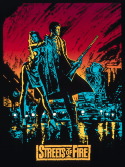
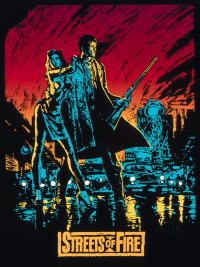
A box office bomb at the time of it's release, and as flawed of a film as it is, it's one that's always stuck with me. With the subtitle "A Rock & Roll Fable," this film tells the story of singer Diane Lane returning to her hometown for one performance, only to be kidnapped by Willem Defoe's biker gang.
That's when Deborah Van Valkenburgh sends a wire to Lane's old flame, her brother, Michael Pare as Tom Cody, a mercenary for hire, shows up from parts unknown to rescue her. It's the type of stripped down, no-nonsense story that writer/director Walter Hill ("The Driver," "Southern Comfort," "Undisputed," etc.
) excelles at, but what made this film so memorable for me was stylized setting and genre mashup, mixing elements of action, musical, and juvenile delinquent films. I remember Hill saying he was trying to make the type of film he would have loved at a kid.
The film features cars, fashions, music, and locations that look straight out of "Blackboard Jungle" or "The Cool and the Crazy," but with a neon soaked 1980s twist. In many ways, "Streets of Fire" feels like a stylized extension of Hill's earlier film "The Warriors," which at once felt gritty and realistic while also had an unreal aspect to it.
"Streets of Fire" takes the visual stylistics of "The Warriors" to the next level, but instead of a Homeric Odyssey, this film is more of a fairy tale with greasers. 18-year old Diane Lane, in what was probably her first glamorous adult role, is amazing as Ellen Aim.
She's strong, gorgeous, and overcomes Hill's usual misogyny. Her singing had to be dubbed, but she looks great on stage during the musical numbers. Incidentally, Stevie Nicks wrote all of the Ellen Aims songs.
The villain of the picture, Willem Dafoe as biker gang leader Raven Shaddock, without question steals the movie and every scene he's in. At this point in his career, Dafoe was a complete unknown and his only lead role was Katherine Bigelow's little seen "The Loveless" (where he also played a bike gang leader), but it's so clear from his performance, even when playing what's essentially a comic book villain, he's a talent to be reckoned with.
It's also a lot of fun that Dafoe's sidekick/number two/lead henchmen is played by Lee Ving, the harsh voiced lead singer for the seminal punk band FEAR. There's also a early appearance by Robert Townsend as a backup singer.
Which brings us to the films major weakness, which is a laconic and lifeless performance by Michael Pare in the lead. Pare looks the part, tall, dark, handsome, but lacks the charisma to pull off a hero the film needed.
When we needed a Steve McQueen or a James Dean, we end up with a Tab Hunter or a Troy Donahue. Pare is not terrible, but he's not what the film needed. Still, the music, the 50s/80s production design, the strong cast (minus Pare), and that awesome climactic sledgehammer fight are terrific and enough to make this film something of a minor classic in my mind.
Overall, this hybrid musical/comic book/1950s juvenile diligent picture/action film somehow manages to overcome it's shortcomings to remain worth watching and deserving of cult status. And if you needed to know, as I finish writing this review, I now have "I Can Dream About You" stuck in my head.
FUN FACT! A low budget unofficial sequel called "Road to Hell" was made in 2008 with Pare not as Tom Cody, but as Cody, and Valkenburgh playing "Sister," and the Ellen Aim character now called Ellen Dream.
Hill has no involvement in this spiritual sequel, but he had originally planned for there being a series of Tom Cody stories (a plan that was scuttled after the film's disappointing box office returns).
This review of Streets of Fire (1984) was written by Allan C on 28 May 2018.
Streets of Fire has generally received positive reviews.
Was this review helpful?