Review of Stranger Than Paradise (1984) by Ivan D — 02 Sep 2010
I look at the year this film was made(1984) and found how well it has aged. Maybe it's the unusual style, or the effortless telling of the story itself, but one thing's for sure, and it's my conclusion that I have really seen something very special.
Honestly speaking, after my last viewing of Jarmusch's fiasco "The Limits of Control", I have expected this film to be another pretentious exercise of the said medium: Lots of philosophical nonsense and pseudo-intellectual displays.
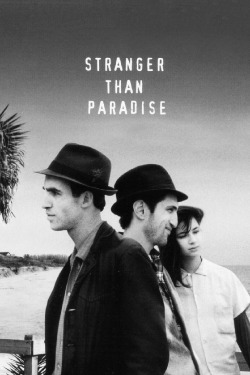
But quite the contrary, "Stranger Than Paradise" surprised me at how simple its narrative really is, with wide scenes only a quarter filled with its three major characters, but their unorthodox relationship and mutual bond is enough to fill the entire screen with immense presence (although one which is bound by simplicity).
It's a slow-moving, observing film, with Jim Jarmusch using black and white to create an unusual sense of emptiness and solitude even in the most mainstream of places(New York, Florida). Black and White color is used vastly in films with different reasons: Be it to conform with budget constraints, to be considered as an artistic expression, or even as simple as a colorization of a flashback in a full-color film.
But never has it been mentioned that it's used to transcend a film's time of creation; well, that's the case for "Stranger Than Paradise".
This review of Stranger Than Paradise (1984) was written by Ivan D on 02 Sep 2010.
Stranger Than Paradise has generally received very positive reviews.
Was this review helpful?