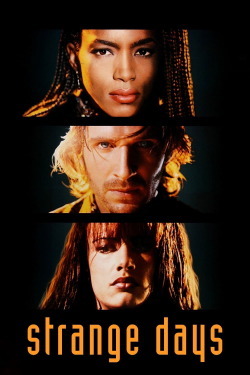
Review of Strange Days (1995) by Colginator — 29 Jun 2019
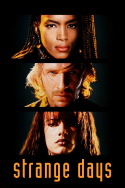
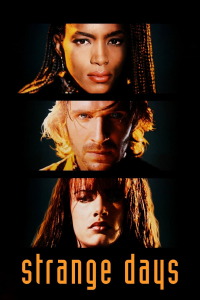
It's strange to think that there was a time before James Cameron became the multi-billion dollar box office king who made both Titanic and Avatar that it was possible for him to be involved in a box office flop. But back in 1995 he wrote the film Strange Days and gave the directing reigns to his ex-wife and action auteur Kathryn Bigelow and somehow, even with these great talents behind the scenes, the film only made 8 million dollars on a 42 million dollar budget. Which is a shame, as it's probably one of the high points of sci-fi action in the 90s.
Taking place in the "futuristic" world of 1999 on the edge of the new millennium, the city of Los Angeles is on the verge of complete chaos with armed police marching the streets. Cameron took heavy inspiration from the Rodney King riots which helped make the film feel very dystopian, but still feel like a future that wasn't necessarily too far off. And with the racial tensions between police and the African-American community still being very prominent today, the setting of the film remains depressingly relevant.
Though the biggest difference in this world is the implementation of an illegal black market technology known as SQUID. It's the ultimate leap forward in VR technology allowing the users to experience the memories and sensations of others. The technology is sold as the ultimate form of Voyeurism, which Biggelow lets us experience by switching the film to a first person perspective whenever a character experiences these memories. When it was released these sequences seemed to get a lot of criticism as being like an exploitative snuff film, even going as far as to show us brutal rape sequences, but that's kind of the point. The film wants us to see how far morality has decayed in this society by directly confronting these twisted fantasies.
It's our lead Lenny who deals in exploiting these fantasies. He's played by Ralph Fiennes as the ultimate sleazeball, always trying to talk his way out of any situation and dragging others down by trying to push SQUID on to everyone he meets. But he also has a sentimental side, obsessing over SQUID memories of his ex-lover Faith and being seemingly unable to move forward in his life in any real way. It's this sentimental core that keeps us rooting for him even when he making genuinely awful decisions.
But when a close friend becomes involved in something which leads to her being horrifically murdered and he is worried that Faith may be involved, he sets out to find the killer and finds himself in a position where he is unable to turn to the police for help. And with the city more on edge than ever before after the murder of a black political rapper Jeriko One, he starts to find that he's on the verge of the one thing that could push the city in to complete chaos.
He's helped out by his close friend Mace, played by Anjela Bassett, who is one of the most overlooked action heroes of the 90s. She is what Furiosa was to Mad Max Fury Road, being a very genuine moral core of the film and taking centre stage in most of the action sequences. But she isn't just present in the film to support Fiennes, instead she is willing to confront him when she believes he is in the wrong and regularly condemns him for his use of SQUID. This is mixed with the fact that Bassett and Fiennes share some great on-screen chemistry which really sells us the strong history between the two characters. It's just a shame that outside this pairing the rest of the cast either comes off as being tonally bland or miscast for their roles.
But what really makes this stand out to other action movies from this decade was the way in which it tackled some heavy themes like racial relations and police brutality. Unsurprisingly for the director who would later go on to make one of the most disturbing representations of police prejudice in Detroit, Kathryn Bigelow does not hold back when tackling these heavy themes. These themes are such a fixture of the film that it seems like this that they feel present in almost every scene, becoming so routine that the characters have to go on with their days whilst the world is practically erupting around them. She also doesn't try to simplify these issues, showing us how they are systematic that are not just rooted in a few individuals.
Though it's because of Bigelow's directness in tackling these themes that the films original failure at the box office isn't too surprising. It's heavy themes mixed with the fact that there weren't as many shoot outs as other action films from this decade meant that this was always going to be a tough sell to audiences. However it's the way that the film tackles these themes so confidently whilst combining it with a great story and some strong lead performances that I'm surprised that this film hasn't been able to pull off a stronger cult following.
This review of Strange Days (1995) was written by Colginator on 29 Jun 2019.
Strange Days has generally received positive reviews.
Was this review helpful?