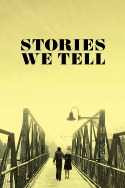
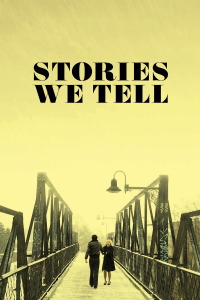
Review of Stories We Tell (2012) by Donovan M — 11 Nov 2013
A frustratingly inadvertent success. In its choice of such a cozy, rosy title for a movie all about lies, it announces that it is a naively open, ideological celebration of bad consciousness. Fortunately, it's eventually quite insightful, since its participants refuse to collaborate with the story the movie wants to tell, undermining its dishonesty and making it better than it intends or deserves to be.
Polley structures the movie through the dishonest lens of pseudo-objective "tell both sides" postmodern journalism: rather than attempt a factual account of her mother's secret life, she suggests that giving equal weight to the personal stories of everyone involved will magically produce truth, or at least a comforting, everyone's-happy-and-nobody's-wrong "truthiness." To her credit, she doesn't stoop to her sister's "no tree fell in the forest" sophomoric relativism, which declares that inconsistencies in stories don't indicate error, for behind stories there are no true events at all!
If you're counting, this is the first lie-ahem, "story"-the movie will try to tell. It is bargain basement Nietzschean perspectivism, with all of the danger and none of the sophistication or cleanliness of intellectual conscience. It's a poor philosophy of art, an atrocious philosophy of documentary film.
At times it's tempting to believe the movie has a sliver of self-awareness. For example, there is the almost gag-like reveal of lie number two-again, a story told by the movie to the audience. The movie relies on conveniently plentiful, well lit and directed home-movie footage, but late in the film Polley shows herself talking on set with the actress who has been playing her home-movie mother. The shot is never acknowledged in the narration. Did Polley intend for us to believe the home movies were real? Is all of the footage reenacted? We might even begin to wonder if the whole project-including not just its perspectivist theory of truth, but every event and every interviewee-is fictional.
The film's naivety really begins to beggar disbelief with movie-lie number three: after discovering the truth about her mother's infidelity and her biological father, Polley and her siblings agree not to tell their father. They, like their mother's friends years ago, protect their mother's story. And Polley begins a secret father-daughter relationship with her formerly unknown biological father. Is this for real? Can a movie about lies, stories, infidelity, and the elusiveness of truth fail to notice the strange self-implication that she's "cheating" on her father with her father?
The ruse fails, all fathers learn the truth, and both turn out to be non-cooperative with the film's "all stories are equal" formula. Thankfully: because then it gets interesting. Sisters, brothers, aunts, and friends have no qualms about distinguishing truth and lie, even when they're doing the lying. Her biological father points out that it was his and her mother's affair-no one else has some equal de facto right to the truth of their story. He also says he just loves a good story, implying out that all fiction is inseparable from motivated deception: he wants to believe his life is a "good yarn," rather than what it really was: a missed life, a failed story. Polley's non-biological father even responds to her explanation of the film by pointing out that it's really about the stories she's telling herself. She seems honestly surprised.
And so these non-cooperative, conscientious objectors save the film by providing its greatest insight: the "stories we tell" are told first to ourselves. Her mother's first lie to herself is that she is a successful rather than middling actor, a lie that necessitates another: that she has an exciting successful second life in Montreal, without children or husband, surrounded by true peers. And these lies depend on the truth as their prop: without her settled, mundane life in Toronto, the fantasy life would be impossible. Preserving both then necessitates further "stories"-to her husband, of course, but also to her children and above all to Polley: the story that her father is her father.
And since husband and children depend on the same "story" of domestic happiness and stability, the next round of self-deception is on them. The husband recalls joking about the fact that Polley didn't look like him; the family even made a tongue-in-cheek game of "who's her real father?" He doesn't admit that it's clearly a game of self-deception on his part, displaying again the embarrassment-free naivety that is the film's hallmark. Polley's siblings knew the truth early on, but played along, paying forward the storytelling game. Her non-biological father admits his failings as a husband, and we realize that he retells his wife's story to himself to protect himself from those failings. Finally, her biological father never recovered from the end of the affair, carrying on an imaginary life with lost wife and daughter for years, propping up the lie in order to keep alive his own lost hopes. Lies can kill, but more often they take away another's ability to truly live; imprisoning them in mere stories.
And so, despite itself, the film unpacks quite well the reality of what stories are and how they function. Stories are "Lies We Tell (Others to Prop Up the Lies We Tell Ourselves)." Perhaps that title would have given too much away? Or perhaps it's just not a lesson any artist or audience wants to learn voluntarily.
This review of Stories We Tell (2012) was written by Donovan M on 11 Nov 2013.
Stories We Tell has generally received very positive reviews.
Was this review helpful?