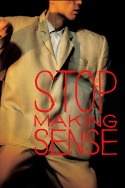
Review of Stop Making Sense (1984) by James J — 03 Jan 2012
I was passionate about music long before I became passionate about film. It began when my neighbor played Hunky Dory to me, and became stronger through school as I discovered the likes of Pink Floyd, Neil Young, Joy Division, The Fall and too many punk bands to mention. We shared albums on cassette and I started listening to the John Peel show on the radio. He broadened my appreciation for obscure music. I mention this because Talking Heads were a big part of my musical education. I remember playing Fear of Music to death when it came out.
David Byrne is not a conventional singer. In fact, very few of the bands I love have people who can really sing. It's just not a requirement for me. I prefer vocalists who obviously feel what they are performing, even if their vocal ability is limited. A list of my favorites would include:
Ian Curtis - Joy Division.
Neil Young.
Stephen Malkmus - Pavement (can change key several times during a line).
Black Francis - Pixies.
Tom Verlaine - Television.
David Bowie.
Kristin Hersh - Throwing Muses.
Polly Harvey.
Nick Cave.
Thurston Moore/Kim Gordon/Lee Ranaldo - Sonic Youth.
Kurt Cobain - Nirvana.
Jonathan Richman - The Modern Lovers.
Mark E. Smith - The Fall.
Byrne whines, growls, yelps and screams. It works...for me. It may not work for everyone. The same goes for most people on the above list. That's why all those bands, and Talking Heads, don't sound like anyone else. They have their own identity. It amazes me that bands like Television don't get more recognition. Marquee Moon (arguably the best album of the 70s) is an absolute masterpiece of guitar sound, but they were labeled as punk/new wave and never got the recognition they deserved. I'm one of their 17 fans across the world.
Talking Heads deserve a special place in music history and the band was inducted into the Rock 'n' Roll Hall of Fame in 2002. Their sound isn't exactly rock, but what is it? There's a huge funk influence as well as world music.
The rhythm section was superb with Chris Frantz (drums), Jerry Harrison (guitar, keyboards) and Tina Weymouth (bass) all vital to the mix. For the purposes of this film, the band was joined by Bernie Worrell (keyboards), Steve Scales (percussion), Alex Weir (guitar), Edna Holt (backing vocals) and Lynn Mabry (backing vocals). The result was an intricate fusion of styles with multiple layers of sound. This complicated layering is prevalent among bands I have grown to love over the years.
The movie doesn't look like a movie at all; it looks like a live concert. It was filmed over several nights with cameras being positioned in different places each time. As a result, you won't see cameras cluttering the performance. It explains how we were given views of the audience from behind the drums without any other cameras in view. The shooting style is somewhat similar to that used in the dance scenes in Black Swan. You'll find yourself on stage with the band, right among the action.
The concert begins with David Byrne walking out carrying a boom box. He wants to play us a tape. It consists of the pounding backing beat of Psycho Killer and he performs it solo with his guitar. Tina Weymouth joins him for a rendition of Heaven, with Chris Frantz entering for Thank You For Sending Me An Angel and Jerry Harrison completing the foursome on Found A Job. The guest performers all add something to the sound and all nine performers are on stage for the start of the seventh song. I have seen Byrne use this formula for solo shows and it works well. I think it highlights what each musician adds to the sound and helps you appreciate exactly how much is going on in that rhythm section.
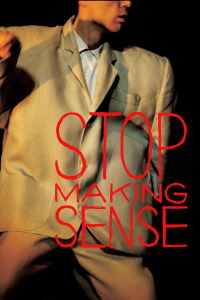
Byrne was a ball of energy, running on the spot, doing laps around the stage, leaping up beside the drums and performing a variety of patented moves. When the ensemble plays the Tom Tom Club's Genius of Love, Byrne leaves the stage. When it ends, he returns wearing the big suit. He wanted to make his head look smaller so he decided to make the rest of his body appear bigger. I think Byrne was one of the best front men in music history. Looking like a cross between a manic bird and Norman Bates, he was never still.
One of the gripes I have about popular music is that it's too manufactured. The record labels want a product that can be marketed and exploited. As long as those involved look the part, the music is secondary. That wasn't the case with Talking Heads. This was real. Look at their faces and how much they enjoyed the performance. Look at the effort involved.
The music is full of emotion.
There are 16 songs included in the 88 minutes:
1. Psycho Killer.
2. Heaven.
3. Thank You For Sending Me An Angel.
4. Found A Job.
5. Slippery People.
6. Burning Down The House.
7. Life During Wartime.
8. Making Flippy Floppy.
9. Swamp.
10. What A Day That Was.
11. This Must Be The Place (Naïve Melody).
12. Once In A Lifetime.
13. Genius Of Love.
14. Girlfriend Is Better.
15. Take Me To The River.
16. Crosseyed And Painless.
No weak tracks there. It's not quite the perfect set, but it's close. Don't Worry About the Government would have been a nice addition.
This review of Stop Making Sense (1984) was written by James J on 03 Jan 2012.
Stop Making Sense has generally received very positive reviews.
Was this review helpful?