Review of Stoker (2013) by Timothy A — 04 Sep 2013
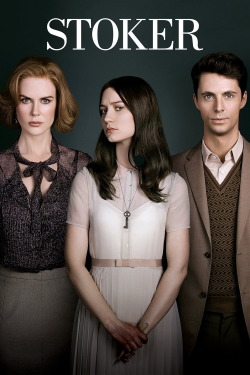
Park Chan-wook's ("Oldboy," "Sympathy for Lady Vengeance") latest film "Stoker," available on Blu-ray and streaming tomorrow, stands apart from his earlier work for a number of reasons. It's the Korean director's English language debut. It's the first time he's directed a film without co-writing' the film's coming from "Prison Break" star Wentworth Miller. But it's an indelibly Park Chan-wook film, full of ornate detail, vertiginous mise-en-scène and operatic verve.
On her eighteenth birthday, the cold and quiet India (Mia Wasikowska) must cope with the sudden death of her father and the unsettling appearance of her heretofore unknown Uncle Charlie (Matthew Goode), a figure of great charisma and boundless menace who moves in with India and her distant mother (Nicole Kidman). While Park has never been a subtle filmmaker, when working with Miller's symbolism- heavy script the film comes off as almost comically obvious at times. But once cinematographer Chung Chung-hoon's poetic imagery and Clint Mansell's swirling score have time to do their work, "Stoker's" baroque diorama becomes real and hypnotic.
The film only flirts with realism and isn't overly concerned with plot but from a perfectly realized early sequence where a birthday cake's flames are slowly extinguished under a hastily applied glass dome, it's clear that "Stoker" is a work of arch impressionism; and you're either along for the ride or you're not. The relationship between India and Charlie - a dance of barely restrained eroticism and familial concern - is as repulsive as it is compelling. A lesser director would have rendered their relationship, with its clumsy Freudian interplay, as crass and sleazy, but Park's restraint manages to give it a tantalizing ambiguity right until the end.
Wasikowska plays India's ambivalence about Charlie, her stifling small town and the real meaning of her father's death with a clear and light touch. She expresses a greater range than ever before, selling profound lust and sneering petulance with ease. And the clarity and wholeheartedness with which she embraces evil suggests a depth that will lead Wasikowska beyond scowling ingénue parts. By contrast, Nicole Kidman is severely limited by a lack of ability and surgical enhancement but is used well as a woman incapable of empathy. When expressing her deep desire for her daughter to suffer, Kidman is terrifying. Once again, she proves to be a better monster than compassionate human being. Matthew Goode is better here than he's ever been. He's sexiness is matched only by his calm viciousness and in the brief moments when he allows his mask of sanity to slip, rank among the finest that Park has ever filmed.
It'd be easy to dismiss "Stoker" as less than the sum of its influences. From an ominous shot of a police officer's mirrored sunglasses to key exposition delivered by laughably over-loud background dialogue to the crushingly obvious parallels to "Shadow of a Doubt," it's undeniable that Miller and Park owe a debt to Alfred Hitchcock. But it's not a sin to make one's reference points clear. Like Nicolas Refn's "Drive," the pleasures of the film don't come from spotting the bits of meticulously crafted homage but from new variations on older techniques and tropes. For example, Hitchcock would have never made a film about nascent female sexuality from a woman's perspective. Being conceptually thrilling and immaculately executed can be more important than originality.
This review of Stoker (2013) was written by Timothy A on 04 Sep 2013.
Stoker has generally received positive reviews.
Was this review helpful?