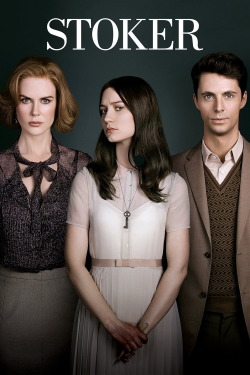
Review of Stoker (2013) by Shiira — 12 Aug 2013
Prior to and superseding Old Boy, the penultimate film of Park Chan Wook's Vengeance Trilogy, incest is intimated(whereas incest becomes actualized in the 2003 Cannes Grand Prix winner), a forerunner to Stoker, his American major studio debut, where sexual tension between an uncle and niece is unequivocally stressed.
At the outset of Sympathy for Mr. Vengeance, a mute brother and his dying sister hold each other like lovers as they look out toward the coastline, while over the soundtrack, the brother's letter is read over the radio airwaves, a letter that promises his beloved sibling, a kidney.
During the convalescence, she allows Ryu to wipe down her arms and legs in the nude, save for a towel, a sponge bath that conveys the potential for transgressive intimacy. It's the ease and lack of self-consciousness about exposed skin from the pair which suggests a chummy history.
In Lady Vengeance, incest is employed as metaphor, when Geum-ja, a parolee wrongly accused of child murder, has sex with a bakery co-worker who sees her as an "elder sister", a teenager at least fifteen years Geum-ja's junior.
Incest, however, in Old Boy, rises above the subtext and begets two separate but interlocking interfamilial relationships that climaxes into the most tragic of tragi-comic endings. It's only natural that the South Korean filmmaker would choose to remake Shadow of a Doubt, the perviest of films in the Alfred Hitchc*ck ouevre.
Not for nothing, in Stoker, does Evelyn, the mother, brag to Uncle Charlie, her brother-in-law, about the recently widowed woman's ability to speak perfect French, since Francois Truffaut(The Bride Wore Black) famously refashioned tropes to his own European art-house sensibilities, as does Wook Park(working from a script he didn't pen), who ferrets out the depravity that courses through the veins of Charlie and Young Charlie(visually linked by matching introductory shots of them lying down on beds) in Shadow of a Doubt, Our Town's shadow, the 1942 film with a similar double-barreled incest storyline as Old Boy.
"Have you ever seen...yourself," India asks a boy, "...from an angle you don't get to see when you're in the mirror," while walking in the woods, just prior to his attack on her. Stepping out from behind the trees, Charlie rescues India, giving his niece a chance to flail away at her oversexed classmate, after he bonds his wrists and ankles together.
Very obliquely, India's little speech recalls Old Boy, when Soo-ah allows Woo-jim, her brother, to molest the consenting schoolgirl in an empty classroom, going so far as taking out a compact mirror so she can get a better look at this familial lover giving her exposed breasts a tongue bath.
She then tilts the mirror up to her smiling face. Echoing India's words, the smile says, "That's me. That's also me." Comparably, that's India in the bathroom, staring at herself, too, in the looking glass, before she enters the shower, where a different, more grisly recount of the boy's murder by Uncle Charlie's hands play out; a murder fantasy that serves as onanistic material for autoerotic sex under hot water.
Both violence and taboo love turns India on. But what about Young Charlie? The filmmaker, in Stoker, makes more explicit the sexual longing and violent disposition already inherent in the uncle's namesake, whose "miracle" could be comparable to India's "longing to be rescued, to be completed," if not for the oppressive sexual climate of her times.
Whereas India is an only child, mourning the sudden death of her father, Young Charlie has a full complement of parents and siblings. It's this stable family life, perhaps, that helps stave off her incubated unwholesome side which the uncle tries desperately, but fails to activate.
Like Young Charlie, India is in simpatico with this long-lost uncle, sharing her counterpart's gift of telepathy, in which she hears Charlie's words of introduction from afar at the funeral. In Shadow of a Doubt, Young Charlie hums a few bars of the "Merry Widow Waltz", to the dismay of her uncle, who later attempts to romance his niece with an emerald ring.
Earlier, through visual metaphor, Hitchc*ck shows how he wants to deflower Young Charlie. But what about the girl? Is she willing? It must be sexual attraction that prevents Young Charlie from turning the Merry Widow Murderer in? That much is made clear when, analogously, India doesn't report the discovery of their housekeeper in the family's pantry freezer.
Back at the funeral party, India observes, "You look like my father," and because he's her uncle, she can safely realize her daddy fantasies without guilt. When Evelyn catches Charlie helping India slip into a pair of high heels, it confirms, perhaps, something she always suspected about her husband and daughter.
Like Min-Sik(who beds his daughter), India, the "young girl", doesn't fully realize who the person she's attracted to really is.
This review of Stoker (2013) was written by Shiira on 12 Aug 2013.
Stoker has generally received positive reviews.
Was this review helpful?