Review of Still Alice (2014) by Kevin C — 02 Sep 2015
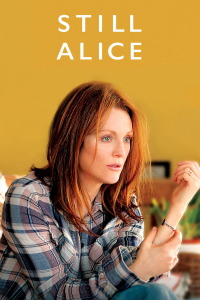
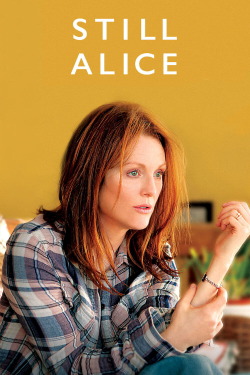
Dr. Alice Howland (Julianne Moore) has it all. She's a highly respected linguistics professor, a loving wife and mother, and is at the point in her life where youthful vulnerability has vanished - she's worked hard, and now, at fifty, is able to live happily as success prospers with certitude. But everything she's come to understand about herself comes crashing down as her usual intellect begins to betray her. She gives a lecture and blanks out on a word that would normally come out of her mouth like a long-kept secret. She goes for a jog on campus and gets lost. She forgets how to make her familial favorite bread pudding recipe for Christmas dinner.
Immensely worried about her current mental state, she goes to a neurologist, her mounting forgetfulness too pressing too ignore - to her horror, she is diagnosed with Early-Onset Alzheimer's Disease, genetically inherited and spreading fast.
The premise of "Still Alice" is predictable, going through the usual "disease film" motions as its protagonist is diagnosed, tries to function with the disease impairing her every move, and, eventually, finally abandons dignity and succumbs to the effects of the illness. Not much is left for a plot twist, but a film like "Still Alice" doesn't have to be tricky to be effective - success has to do with the actors and filmmakers involved, and the people behind and in front of the camera do more than just make another "disease of the week" movie. They create a moving one, studying the ripples an earth-shattering disability can have on a person, their family, and their livelihood. To see Alice go from the smartest person in the room to the most handicapped is crushing, and the film doesn't attempt to romanticize the reality of the situation.
Glatzer and Westermoreland aren't necessarily trying to depress us, to give a voice to the many victims of Alzheimer's; their unfiltered goal is to piece together a convincing slice-of-life drama, a slice-of-life drama that just so happens to be relentlessly tragic. The brutal truths that emanate off of "Still Alice" are refreshing - in an era where most films of the same nature attempt to go the Oscar bait route instead of a different, poignantly inhibited one, it's inspiring for such a movie to turn no tricks, to unspool agonizingly without the usually expected emotional breakdowns that screech for award attention.
Perhaps "Still Alice" seems so effective because of Moore's performance: providing for a characterization that may as well be her all-time greatest, she is positively magnetic, breaking our hearts just as easily as she galvanizes a jaw drop. The unraveling of Alice burrows under our skin like a parasite, affecting us at times we least expect to be overwhelmed. Consider the scene where Alice and her husband (Alec Baldwin) prepare to go jogging and she quickly goes off to the bathroom before they embark. A task normally simple to the woman suddenly becomes an obstacle course as she can't remember where the bathroom is, soon forgetting where she is altogether. Beforehand, Alice's many plights made her seem like a functioning victim, her deterioration slow and only subtly crippling. But as it heads sharply downward and denial can hardly be an excuse, we are forced to confront our own feelings as Alice finds herself stunned at how much she's changed in the course of a few months. Moore is phenomenal, capturing her character's degradation with an instinctiveness frightening in its believability.
The supporting performances are, of course, eclipsed, but Stewart (as the outsider daughter who confronts the situation with surprising emotional maturity) and Baldwin (as the husband who never abandons his once admirable wife as she becomes harder and harder to care for) are just as empathetic as Moore, perhaps even more so as they have more in common with the viewer, sitting back and helplessly watching in horror as the woman they adore evaporates before their very eyes. As a film, "Still Alice" is unremarkable only because it moves along with too much inevitability to really feel alive - but Moore and the players that surround her are excellent, and the writing and direction is stunningly honest. It's a sobering tale of illness hard to write off. It's too close to the heart.
This review of Still Alice (2014) was written by Kevin C on 02 Sep 2015.
Still Alice has generally received very positive reviews.
Was this review helpful?